
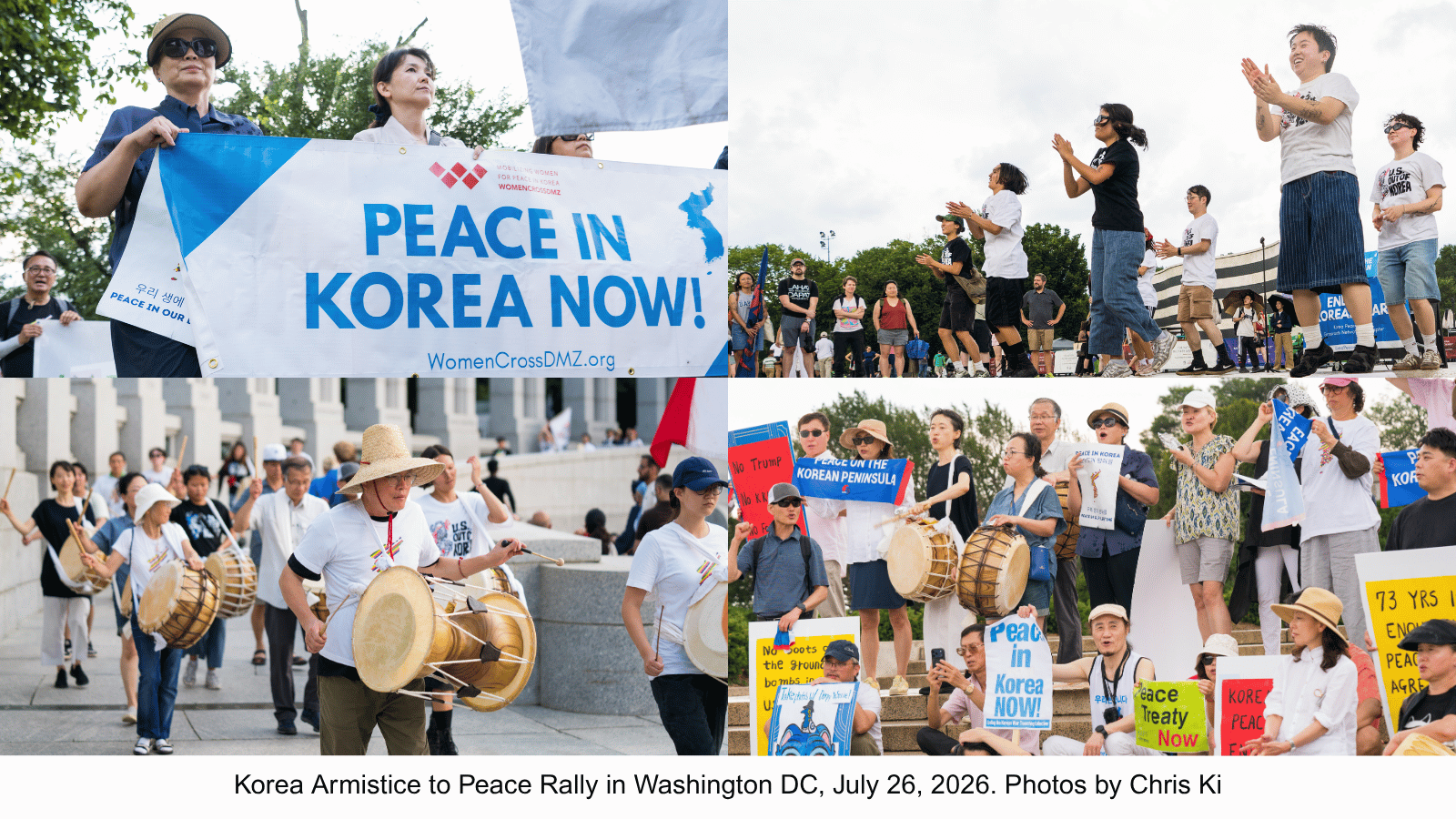
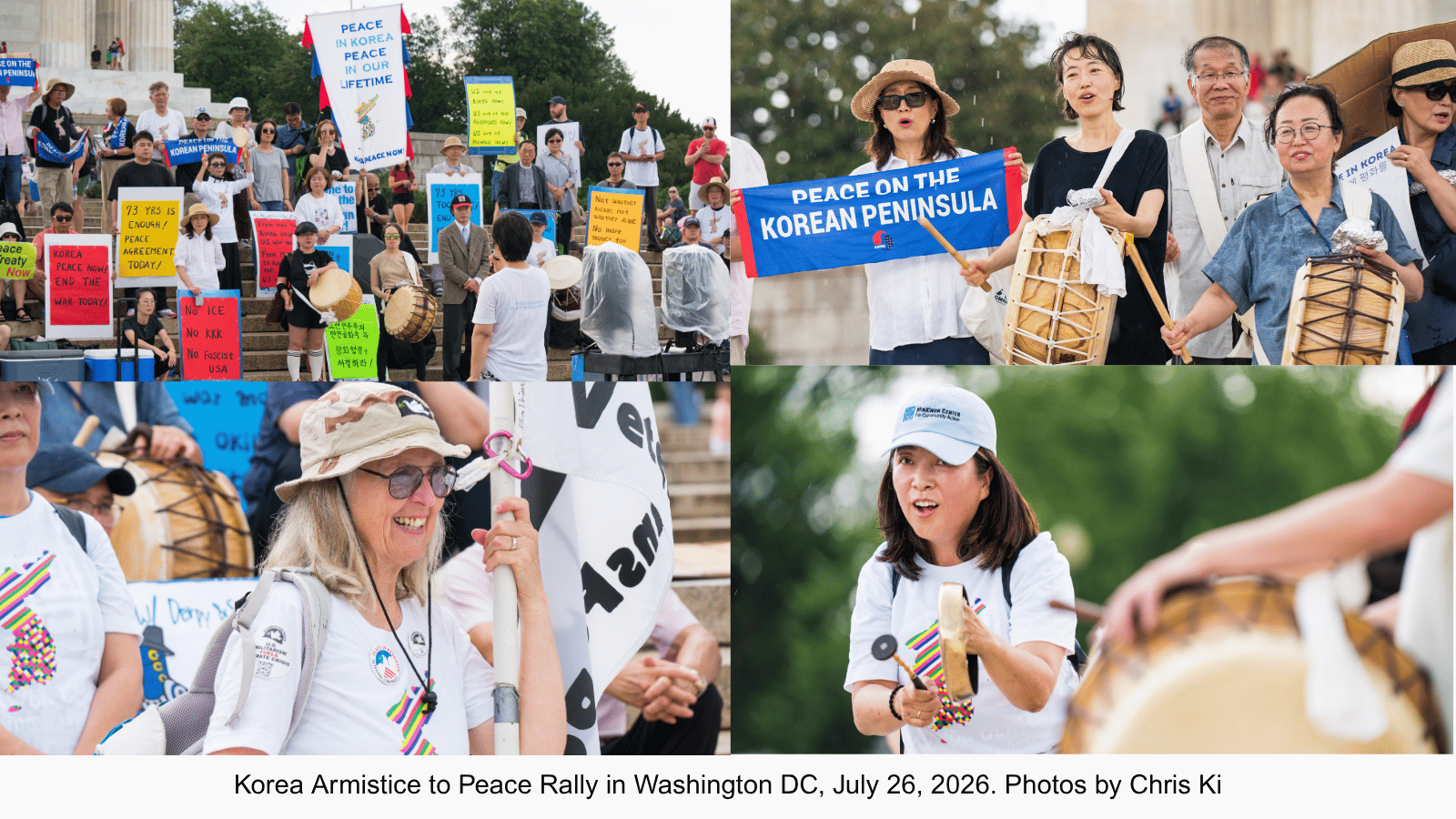
Dear Friend, Today marks 73 years since the signing of the Korean War Armistice. This unresolved war is the root cause of ongoing tensions in Korea, fueling the growth of a rampant military industrial complex, keeping thousands of families separated, and restricting humanitarian aid and people-to-people engagement. The United States must bring its oldest “forever war” war to a close. A peace agreement is critical, which is why we marched with over 100 people in the heart of Washington DC yesterday to demand an immediate end to the war and urgent diplomacy in pursuit of a binding peace agreement. Peace advocates joined us from far and wide including VA, MD, PA, NY, NJ, NC, CT, and more.
WCDMZ and partner organizations submitted this Joint Statement Calling for an End to the Korean War signed by over 70 organizations to all Members of Congress today. We co-wrote this statement with fellow members of the Korea Peace Network, an alliance of concerned U.S.-based civil society groups including the American Friends Service Committee, Korean American Peace Fund, Korea Peace Now! Grassroots Network, Maryknoll Office for Global Concerns, Mennonite Central Committee, and the United Methodist Church Church & Society and Global Ministries. Read our press release here.
Our movement for peace is strong and growing! Advocate for peace today.
In LA, Women Cross DMZ joined GYOPO and Nodutdol at “Lessons From the Pacific: Feminist Solidarities Towards a Demilitarized Pacific” on July 9, where over seventy people gathered to learn about the intertwined legacies of militarized prostitution under Japanese colonialism and US occupation in Korea, the experiences and activism of camptown women in Korea, and the landmark lawsuit launched in 2025 by 117 Korean women against the U.S. military for gender-based violence and human rights abuses in military camptowns. We extend our heartfelt gratitude to speakers Dr. Jinah Kim, Dr. Margo Okazawa-Rey, Nodutol, GYOPO, and Soren and Nahmi of Korea Peace Now! Grassroots Network. Thank you to everyone who joined us!
In NYC, WCDMZ Executive Director Cathi Choi joined the Asian American Legal Defense & Education Fund’s inaugural Justice in Action Conference on July 16-17. At this powerful gathering, over 120 participants engaged on issues impacting Asian Americans while learning practical advocacy, leadership, and community-building skills. As a panelist on “Building the Public Interest Toolbox,” we shared how anti-Asian racism in the United States cannot be separated from U.S. militarism abroad, and how escalating tensions with China, the unresolved Korean War, and anti-China rhetoric contribute to xenophobia and create opportunities for far-right organizing. The discussion generated significant interest among participants and opened new avenues for collaboration between organizations working on civil rights, democracy, and foreign policy.
The True Cost of the U.S. Military in South Korea. New research shows that U.S. taxpayers are paying at least $5.5 billion to $6 billion annually to maintain U.S. bases and troops in South Korea, and we urgently need more transparency from the Pentagon and government accountability to calculate the true costs.
South Korea’s Far Right Is on the Rise — With the MAGA Movement’s Backing on transnational far-right movements linking MAGA politics in the United States with democratic backsliding in South Korea.
Hope Springs Eternal For Reduced Tensions and Peace on the Korean Peninsula on reflections from the Naegohyang Women’s Football Club match against Suwon FC Women, the new political landscape in Korea, and a snapshot of WCDMZ’s work this past year.
August 4, 2026 at 5pm PT/8pm ET | Nuclear Bombs Never Again Webinar
Join us on August 4 at 5pm PT/8pm ET for a webinar highlighting the current actions in the anti-nuclear weapons movement and the upcoming Seoul International People’s Tribunal on the 1945 atomic bombings of Hiroshima and Nagasaki. WCDMZ Organizing Director Echo will present. Co-hosts WILPF and Korea Peace Now! Grassroots Network will amplify the cross-generational voices at the intersection of Japan-Korea-US policy and militarization, share their lived experiences, anti-war strategies, and actions you can take to advocate for a world without nuclear bombs. Register here.
September 4, 2026 at 4pm KST | Women Resisting Militarism & Demanding Feminist Peace and Justice Webinar Series
WCDMZ Board Member Ann Wright will speak on the 3rd webinar sponsored by the Asia Pacific Women in Law (APWLD). Register here.
✌️Follow Women Cross DMZ and Korea Peace Now! on Instagram! Say hello and check out our accounts!
🛍 Support the Korea Peace Movement: Show your support for Korea peace with one of our tote bags, hats, baby onesies, and clothing, available here. All funds will support Korea Peace Now!, our U.S.-based movement for peace in Korea led by Women Cross DMZ. Art by Peter Holland and lazy blender.

In peace,
Women Cross DMZ
A Joint Statement Calling for an End to the Korean War
On July 27, 1953, the bullets on the Korean Peninsula stopped firing, but the war never ended. The armistice was always meant to be temporary. The ceasefire was intended to be followed by a peace agreement, but it has still yet to come more than 70 years later. Two generations of Koreans and Americans have grown up under the shadow of a war that was never resolved.
We, the undersigned civil society organizations—people of faith and conscience, Korean Americans, veterans, scholars, and advocates—join our voices to call upon the U.S. government to take responsibility and end the Korean War by engaging the Democratic People’s Republic of Korea (North Korea) in good faith and replacing the 73-year-old armistice with a permanent peace agreement.
The Cost of an Unfinished War
The consequences of this unfinished war can be measured in the continued division of the Korean Peninsula, the tragic and ongoing separation of Korean families, and the extreme militarization and unceasing arms race that define the region. The Korean Peninsula remains one of the most heavily armed places on Earth and one of the world’s most dangerous nuclear flashpoints. Each year the war is left formally unended, the risk of miscalculation, accident, or escalation persists—endangering the security of Koreans, Americans, and all in the region and globally.
This is the United States’ oldest “forever war.” The U.S. spends over $3 billion per year of taxpayers’ money to maintain military deterrence and troop presence in South Korea. Instead of funding an endless cold war, this money should be used for healthcare, childcare, housing, and education. As Americans, we believe we have a duty and a moral responsibility to help bring this war to a close.
A Peace-First Approach Can Pave the Way Toward Security
Decades of failed U.S.-DPRK negotiations show that U.S. policies focused on isolation, sanctions, and military threats have failed to achieve stated goals of denuclearization and security. The United States demanding North Korea’s full denuclearization up front, while maintaining crushing sanctions and continuing military exercises, will not entice North Korea back to the negotiation table. While past talks were aimed primarily at North Korea’s denuclearization, future negotiations that instead address the root cause of the security crisis have the potential to build toward longer-lasting agreements and mutual trust.
A Moment of Limited Opportunity
We recognize this anniversary not only as a moment of mourning, but as a moment of limited possibility. Although Inter-Korean relations have faced significant challenges, the Lee Jae Myung administration has made peaceful coexistence the cornerstone of its approach to the North, publishing a “Policy for Peaceful Coexistence on the Korean Peninsula” and committing to respect North Korea’s system, forgo any pursuit of unification by absorption, and refrain from hostile acts—seeking to lower military tensions and rebuild trust through actions rather than words. The United States also has an opportunity to take steps towards peace.
The American People Support Peace
Ending the Korean War reflects what most Americans already want. A majority of U.S. adults believe the U.S. government should formally end the Korean War by signing a peace agreement, and two-thirds believe the U.S. should lift sanctions that interfere with humanitarian aid and public health.
The public has consistently chosen communication, humanitarian cooperation, and practical problem-solving over confrontation. These are the values that must guide U.S. policy.
Our Call to the U.S. Government
On the occasion of the 73rd anniversary of the Korean War Armistice, we call on the Trump administration to honor the will of the American people and the cause of peace by taking concrete, achievable steps to formally end the Korean War:
A genuine and lasting security cannot rest on the threat of mutual destruction. It must be built on dialogue, mutual respect, and the recognition that the human security of the American and Korean people are intertwined. We carry with us the hopes of divided Korean families, of all who have lived their entire lives under the weight of this unended war, and of the children on both sides of the Pacific who deserve to inherit a peninsula at peace.
The power to end this war exists. We are calling for our leaders to use it.
Endorsing Organizations:

The Trump administration has just extended the travel ban on North Korea until August 31, 2027.
Since 2017, U.S. passport holders have been prohibited from traveling to North Korea. This policy has kept families separated, hindered the delivery of humanitarian aid, and prevented civil society groups and individuals from engaging in meaningful exchanges.
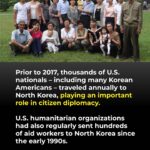
Prior to the ban, thousands of U.S. nationals – including many Korean Americans – traveled annually to North Korea, playing an important role in citizen diplomacy. U.S. humanitarian organizations had also regularly sent hundreds of aid workers to North Korea since the early 1990s.
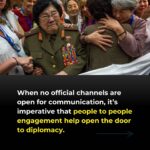
When no official channels are open for communication, it’s imperative that people to people engagement help open the door to diplomacy.
🔗 Sign on to the petition demanding an end to the travel ban now!
Ewa Eriksson Fortier has engaged in international humanitarian work for 40 years, beginning in 1976 by the end of the Vietnam War. For the past decade, Eva has focused on the consequences of the Korean War. She was the head of an international humanitarian organization based in Pyongyang.
