Join us for a webinar on the nomination hearing of Michelle Park Steel for U.S. Ambassador to the Republic of Korea. We’ll hear from speakers including Sandy Shan (Justice Is Global), Mark Tseng-Putterman (New York University), Youngmi Cho (Sejong Cyber University), Goo Lee (Evergreen Coalition), and moderator Cathi Choi (Women Cross DMZ) on Steel’s political record and potential influence as next U.S. Ambassador to the Republic of Korea on the prospects for Korea peace.
As Congresswoman, Steel took a staunchly conservative, hardline approach to China and North Korea, including her firm opposition to efforts to end the Korean War. She has advocated for a more aggressive military posture and spending with the justification of “deterring North Korea” and “countering China.” Additionally, in her reelection campaigns, Asian American and immigrant advocates criticized Steel for promoting divisive rhetoric and weaponizing inflammatory “McCarthyist” imagery.
Speakers will discuss Steel’s nomination as Ambassador to the Republic of Korea, the implications of her track record and recent congressional nomination hearing in the context of current global events – including the May 2026 Xi-Trump summit. We will hear from speakers about the implications of Steel’s nomination for U.S. relationships with the Republic of Korea, China, and countries across Asia and the Pacific.
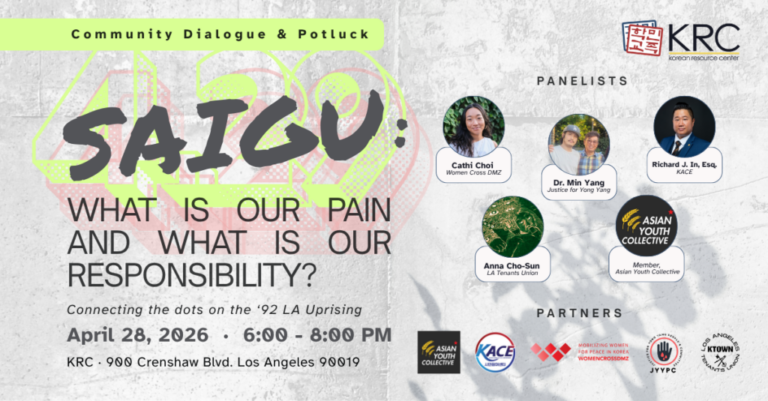
The Korean Resource Center LA (KRCLA) is hosting an evening of conversation and food on Tuesday, April 28 at 6pm PT, as we reflect on Saigu and renew our spirit and purpose as people of the Korean diaspora. We’ll be joined by community activists who have been on the frontlines challenging the systems that sowed the seeds for Saigu.
Panelists:
🌺 Cathi Choi, Women Cross DMZ Executive Director
🌺 Dr. Min Yang, Justice for Yong Yang
🌺 Anna Cho-Sun, LA Tenants Union
🌺 Richard J. In, KACE
🌺 Asian Youth Collective
Tuesday, April 28, 2026 from 6:00 – 8:00 PM
📍KRC Crenshaw, 900 Crenshaw Blvd, Los Angeles, CA 90019
We’ll have plenty of food to go around, but feel free to bring a dish to share!
This is an in-person public event and registration is not required. Reach out to isaac@krcla.org for questions.
Please join our Spring Benefit on March 13, 2026, 5:00 – 7:00pm!
You will meet a special group of our esteemed friends and supporters, and enjoy delicious Korean hors d’oeuvres and lively musical performances. This event will raise much-needed funds and mark the 11th anniversary of Women Cross DMZ – our organization and movement for peace in Korea.
If you would prefer to donate by check or wire transfer, please contact susan@womencrossdmz.org.
Thank you to our generous supporters:
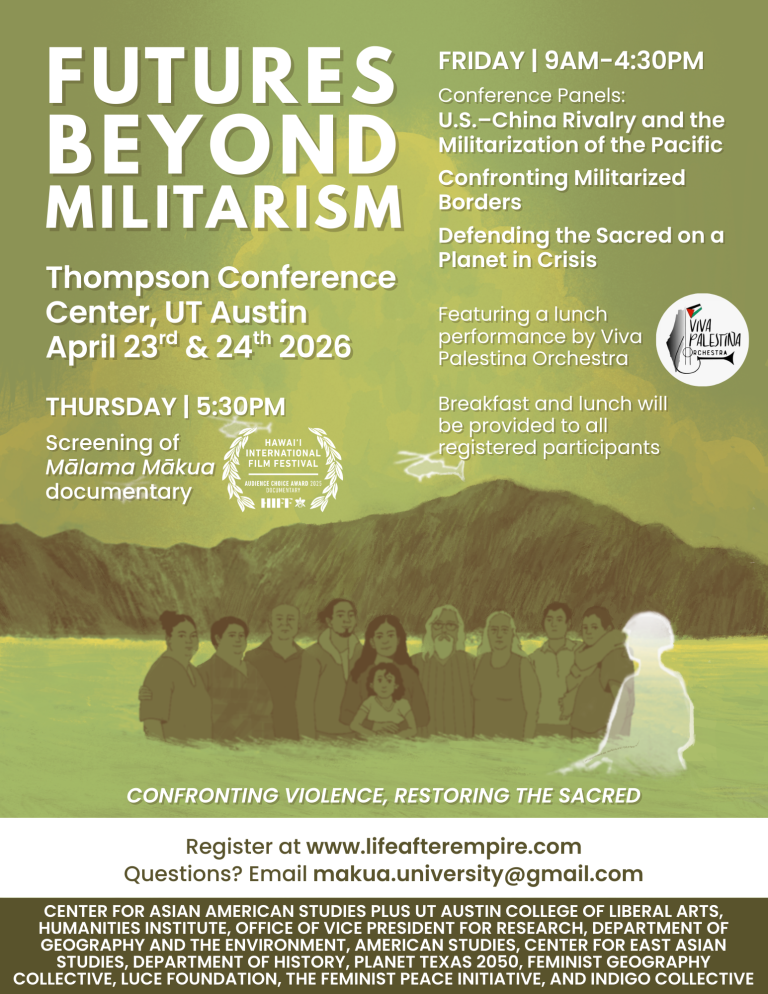
The UT Austin Center for Asian American Studies will host “Futures Beyond Militarism: Confronting Violence, Restoring the Sacred,” a two-day conference bringing together international scholars and activists to examine global alternatives to militarism and ways communities envision and enact sustainable and interdependent futures from April 23-24, 2026. Women Cross DMZ Executive Director Cathi Choi will speak at the “US-China Rivalry and the Militarization of the Pacific” panel event, moderated by Women Cross DMZ Founder Christine Ahn, on Friday, April 24 at 9:45am CT. RSVP and learn more here.
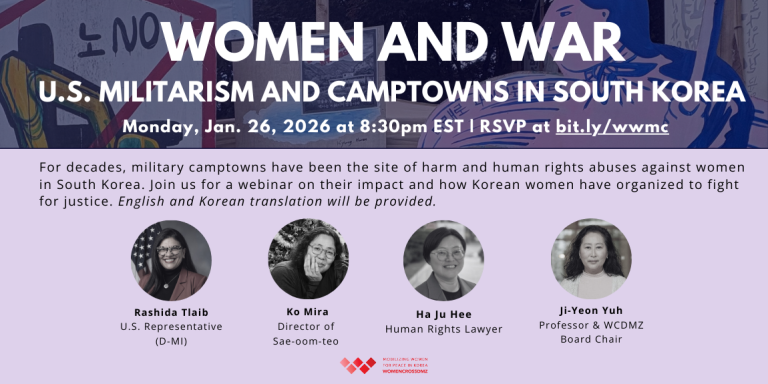
Join us for a webinar on the history of U.S. militarism and camptowns in Korea, and the impact on Korean women on Monday, January 26, 2025 at 8:30pm ET (Jan. 27, 2025 at 10:30am KT) ì¼ì‹œ: 01.27.2026, í•œêµ ì˜¤ì „ 10:30 / 01.26.2026, ë¯¸êµ ë™ë¶€ 오후 8:30.
[sp_easyaccordion id=”17666″]
Studies have long shown that in war and militarism, women are disproportionately harmed and sustain severe human rights abuses. For decades in South Korea, military camptowns surrounding bases have been the site of harm and human rights abuses against Korean women. In 2022, the South Korean Supreme Court found that sex trafficking and illegal prostitution economies existed at U.S. military camptowns from at least 1957 to 2008, and held the Korean government liable for operating and encouraging such prostitution to sustain the South Korea-U.S. military alliance.
This past fall, Korean organizers filed a new lawsuit building on that ruling. The 117 plaintiffs are suing the South Korean government for gender-based human rights abuses inflicted by U.S. forces stationed in Korea (U.S.F.K.). This is yet another chapter in the long history of the disproportionate impact and harm sustained by women in Korea as a result of U.S. militarism.
In this webinar, organizers of the lawsuit as well as scholars will discuss the history of camptowns, human rights abuses against Korean women, and how Korean women have organized to fight for justice. We will hear from South Korean organizer Ko Mira, director of Sae-oom-teo, and human rights lawyer Ha Ju Hee, in a conversation moderated by Professor Ji-Yeon Yuh. U.S. Congresswoman Rashida Tlaib and Veterans For Peace President Susan Schnall will provide remarks. English and Korean translations will be provided.
[sp_easyaccordion id=”17175″]
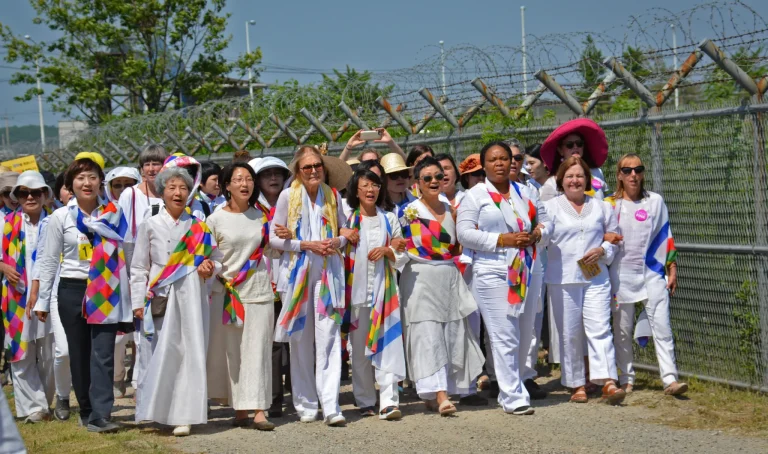
Seoul, Korea — Ten years after a delegation of 30 women peace activists made a historic crossing of the Korean Demilitarized Zone to call for an end to the Korean War, an international delegation of diasporic feminist leaders organized by Women Cross DMZ will join South Korean women activists for a peace walk on International Women’s Day for Peace and Disarmament, May 24, 2025, in Pyeongtaek, Korea.
The walk, which is organized annually by Gyeonggi Women’s Association United, will commemorate the ten-year anniversary of the DMZ crossing and serve as an important reminder of the gendered dimensions of the Korean War. It will be held outside the U.S. Camp Humphreys military base to draw attention to the unresolved war and rampant militarism in Korea.
The international delegation will include Afghan American, Indigenous, Korean American, and South Asian feminist leaders based in the United States. Their transnational act of solidarity is particularly timely as democracy is under attack in the United States, South Korea is on the cusp of electing a new president, and growing tensions between the U.S. and China raise the risk of war in Northeast Asia.
“Women in Korea have been living in the shadow of unresolved war for more than 70 years, bearing the burdens of militarization, division, and separation. We are joining with our sisters from across the globe to take a stand to show that Korean women demand peace and disarmament,” said Lee Jung Ah, Standing Representative, Gyeonggi Women’s Association United.
“South Korea’s women’s rights groups have long highlighted how war and militarism harm women’s rights and gender equality. We walk with international women because global women’s leadership and international solidarity are crucial to ending the Korean War,” Youngmi Cho, Executive Committee Member of the Christian Conference of Asia and Former Executive Director of the Korean Women’s Movement for Peace.
“We are seeing an alarming escalation of militarism in Korea, the U.S., and globally, which threatens democracy. As international feminists, we stand in solidarity with Korean women and uplift calls for lasting peace,” said Cathi Choi, Executive Director of Women Cross DMZ.
“From Afghanistan to Korea, the U.S. has led deadly forever wars across the globe. As an immigrant, child of Afghan refugees, and feminist peace advocate, I am joining the walk in solidarity with Korean women and feminists everywhere calling for an end to militarism and war,” said Arash Azizzada, Co-Director, Afghans for a Better Tomorrow.
“From Rwanda to Bosnia, Kenya, and Nepal, war disproportionately affects women’s lives. My own grandfather was a pilot during the Korean War, and participated in indiscriminate bombing campaigns that killed millions. I am walking in solidarity with Korean women because I know that the violence of war reverberates across generations, and women always pay the steepest price,” said Marie Berry, Professor at the University of Denver, and Director of the Inclusive Global Leadership Initiative (IGLI).
“As a Diné citizen and member of Navajo Nation, I know firsthand how militarism and capitalism have stolen the lands and the lives of generations of Indigenous Peoples. From Daechuri to Turtle Island, we must resist the capitalist war machine and call for lasting peace,” said Janene Yazzie, Diné Human Rights Advocate.
In addition to the peace walk, the international delegation will also hold meetings with fellow women peace organizers across the Korean Peninsula, including at the DMZ, in Pyeongtaek, and at Jeju Island, to build bridges and share tactics. For many in the delegation, it will be their first time in Korea.
When: Saturday, May 24, 2025, 10:00 AM – 12:30 PM
Where: Meet at Pyeongtaek Naeri Cultural Park (260 Naeri, Paengseong-eup, Pyeongtaek-si)
Depart from Naeri Cultural Park -> Road around Camp Humphreys -> Arrive at Naeri Cultural Park (round trip takes 1 hour and 30 minutes)
About Women Cross DMZ:
Since their historic crossing of the DMZ in 2015 to call for the official end of the Korean War, the reunion of separated families, and women’s participation in the Korea peace process, Women Cross DMZ has been building the political will for a peace agreement in the U.S. through education, advocacy, and organizing. In 2019, WCDMZ launched the Korea Peace Now! Grassroots Network and helped to introduce the first Korea peace legislation in Congress.
For more information on the march, to attend, or to arrange an interview with an organizer, please contact info@womencrossdmz.org.
###
Join us on Saturday, May 24 at 5 pm PT/ 8 pm ET for a virtual Crossings screening! RSVP here.
In May 2015 — the 70th anniversary of Korea’s tragic division by the United States and the former Soviet Union — 30 women peacemakers from around the world crossed the Korean Demilitarized Zone, the most militarized border in the world from North Korea to South Korea, calling for an end to the war that has divided the two Koreas. Our delegation included two Nobel Peace laureates, academics, humanitarian aid workers, faith leaders, and others from a dozen countries, including several nations that fought in the 1950-53 Korean War, led by Women Cross DMZ founder Christine Ahn. Deann Borshay Liem’s 2021 film, Crossings, documented this momentous journey for Korea peace.
This is a joint screening with Korea Peace Now! Grassroots Network, Women Cross DMZ, and International Women’s Day for Peace and Disarmament for the 10 year anniversary of the DMZ crossing.
Trailer:
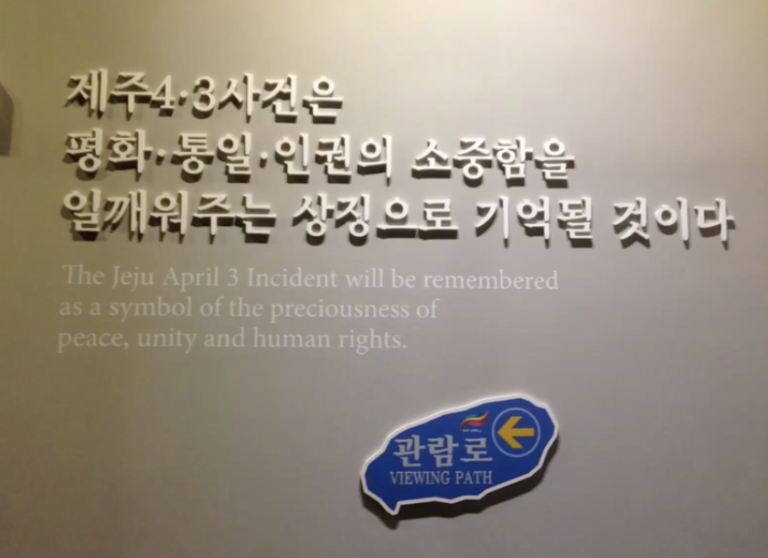
Join us for a presentation on the Jeju 4.3 Tragedy, the villagers’ criminal retrials, and the connections between their 2018 retrials and the 1980s coram nobis reopening of the resistors of the WWII Japanese American mass incarceration.
Eric K. Yamamoto is the Fred T. Korematsu Professor of Law and Social Justice at the William S. Richardson School of Law, University of Hawai`i. He is nationally and internationally recognized for his legal work and scholarship on civil procedure as well as national security and civil liberties, civil and human rights and social justice, with an emphasis on reconciliation initiatives and reparations for historic injustice. Yamamoto’s prolific scholarship includes Healing the Persisting Wounds of Historic Injustice: United States, South Korea and the Jeju 4.3 Tragedy (2021); Race, Rights and National Security: Law and the Japanese American Incarceration (with Bannai and Chon) (Wolter Kluwer 3rd ed. 2021); In the Shadow of Korematsu: Democratic Liberties and National Security (2018 Oxford Press); and The Jeju 4.3 Tragedy: Next Steps Toward Reconciliation (translated into Korean) (co-authored with Pettit and Lee) (2015).
Miyoko Pettit-Toledo is a proud graduate of the William S. Richardson School of Law, where she joined the faculty in August 2022 as an Assistant Professor of Law. She currently teaches Civil Procedure I & II, Advanced Civil Procedure, and Second Year Seminar. Her scholarship has appeared in the Denver Law Review, Berkeley Journal for Gender, Law, and Justice, University of Hawai‘i Law Review, and Asia Pacific Law and Policy Journal, in addition to other publications in South Korea. She is also the co-author of The Jeju 4.3 Tragedy: Next Steps Toward Reconciliation (translated in Korean) (2015) with Professor Emeritus Eric K. Yamamoto and Sara Lee.

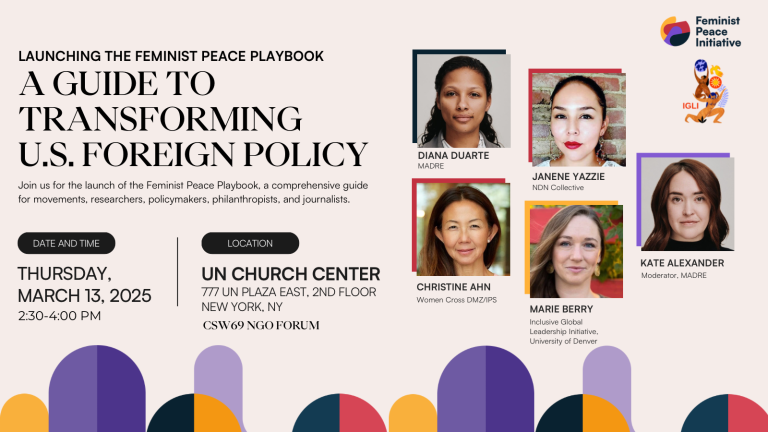
Join us for the launch of the Feminist Peace Playbook, a comprehensive guide for movements, researchers, policymakers, philanthropists, and journalists, released by the Feminist Peace Initiative — led by MADRE, Women Cross DMZ, and Grassroots Global Justice Alliance — and the Inclusive Global Leadership Initiative at the University of Denver.
Speakers:

This ESJF and WCDMZ session highlights the urgent need for accountability and global adoption of key Women, Peace, and Security (WPS) mechanisms, including UN Security Council Resolution 1325 and the U.S. WPS Act. Drawing on cases like “comfort women” in Asia, Sepur Zarco, and South Korean landmine survivors, panelists will discuss the role of WPS mechanisms in addressing the devastating impact of war, militarism, and post-conflict realities on women and families. WCDMZ will launch the report, Women’s Rights Under the Division System, with groundbreaking analysis and research from Korean women.
Register for the session here.
Speakers

Sung Sohn is a former bilingual classroom and resource teacher with the San Francisco Unified School District (SFUSD). In 1994, she founded SFUSD’s first and only Korean/English Two-Way Immersion Program. In 2017, she co-founded the Education for Social Justice Foundation (ESJF), a San Francisco-based 501(c)(3) NGO, where she serves as executive director. Since 2023, ESJF has held special consultative status with the UN Economic and Social Council. Sung also serves as the director of feminist foreign policy at the US Women’s Caucus. Over her career, she has published Korean Two-Way Immersion Curriculum Guide (1994), “Comfort Women” History and Issues: Teacher Resource Guide (2018), and “Comfort Women” History and Issues: Student Resource Guide (2018).

Cathi Choi (she/her) is the Executive Director of Women Cross DMZ, a global movement of activists mobilizing to end the Korean War, reunite families, and ensure feminist leadership in peacebuilding. She co-coordinates the Korea Peace Now! Grassroots Network, launched in 2019 to organize communities in calling for demilitarization and lasting peace on the Korean Peninsula. She obtained a JD from Harvard Law School. Previously, she worked at a civil rights law firm in Los Angeles. Her writing has been published in the Los Angeles Times, Foreign Policy In Focus, In These Times, Journal of Policy History, the Asian Pacific American Law Journal, Yes! Magazine, The Hill, and The National Interest.

Renée Coppock is a partner at Crowley Fleck PLLP, where she has worked since 1987. She earned her JD from the University of Illinois, Champaign-Urbana, graduating with Order of the Coif honors and Summa Cum Laude distinction. Renee has written and published articles and delivered seminars on topics including indigenous women’s rights, water law, environmental law, and conservation easements. Her leadership roles include serving as a director on the Boards for Zonta International and the Zonta Foundation for Women, as well as chairing the Zonta International Bylaws and Resolutions Committee. Additionally, Renee has been a trustee for Montana State University Billings and a director for Court Appointed Special Advocates of Yellowstone County. She currently serves as the Membership Director for the US Women’s Caucus.

Han Mimi is a vice president of World YWCA, an executive board member of the National YWCA of Korea, vice chairperson of international affairs of the National Council of Churches in Korea, and an NGO advisor of “Action with Women and Peace” (A Peace ODA to the Survivors from SGBV in Armed Conflict Areas Abroad) of the Ministry of Foreign Affairs in the Republic of Korea. Mimi is a board member of the Women Migrants Human Rights Center of Korea. The YWCA is a member of the Korean Women’s Movement for Peace.
Moderator

Dr. Marie Berry is the Director of the Sié Chéou-Kang Center for International Security and Diplomacy and an Associate Professor at the Josef Korbel School at the University of Denver. She is also the co-founder and convener of the Inclusive Global Leadership Initiative (IGLI), an effort to elevate and amplify the work that women activists are doing at the grassroots to advance peace, justice, and human rights across the world. Her award-winning book, War, Women, and Power: From Violence to Mobilization in Rwanda and Bosnia-Herzegovina (Cambridge University Press 2018), examined the impact of mass violence on women’s political mobilization in Rwanda and Bosnia. Together with Dr. Milli Lake (LSE), she runs the Women’s Rights After War Project. Dr. Berry’s work has been published in places like the Annual Review of Law and Social Science, Gender & Society, Democratization, Signs, New Political Economy, Mobilization, Politics & Gender, Foreign Policy, Boston Review, The Monkey Cage, and Political Violence @ A Glance. She is a 2021 recipient of a prestigious National Science Foundation CAREER Award.