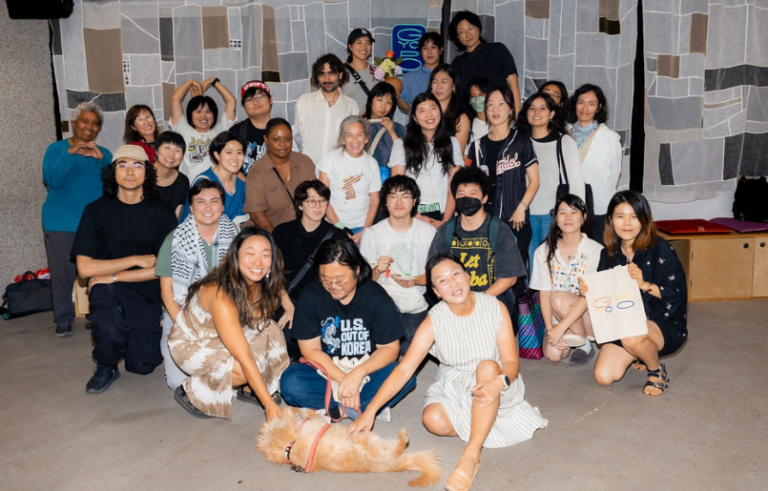
Dear Friend, Today marks 73 years since the signing of the Korean War Armistice. This unresolved war is the root cause of ongoing tensions in Korea, fueling the growth of a rampant military industrial complex, keeping thousands of families separated, and restricting humanitarian aid and people-to-people engagement. The United States must bring its oldest “forever war” war to a close. A peace agreement is critical, which is why we marched with over 100 people in the heart of Washington DC yesterday to demand an immediate end to the war and urgent diplomacy in pursuit of a binding peace agreement. Peace advocates joined us from far and wide including VA, MD, PA, NY, NJ, NC, CT, and more.

WCDMZ and partner organizations submitted this Joint Statement Calling for an End to the Korean War signed by over 70 organizations to all Members of Congress today. We co-wrote this statement with fellow members of the Korea Peace Network, an alliance of concerned U.S.-based civil society groups including the American Friends Service Committee, Korean American Peace Fund, Korea Peace Now! Grassroots Network, Maryknoll Office for Global Concerns, Mennonite Central Committee, and the United Methodist Church Church & Society and Global Ministries. Read our press release here.
Our movement for peace is strong and growing! Advocate for peace today.
In LA, Women Cross DMZ joined GYOPO and Nodutdol at “Lessons From the Pacific: Feminist Solidarities Towards a Demilitarized Pacific” on July 9, where over seventy people gathered to learn about the intertwined legacies of militarized prostitution under Japanese colonialism and US occupation in Korea, the experiences and activism of camptown women in Korea, and the landmark lawsuit launched in 2025 by 117 Korean women against the U.S. military for gender-based violence and human rights abuses in military camptowns. We extend our heartfelt gratitude to speakers Dr. Jinah Kim, Dr. Margo Okazawa-Rey, Nodutol, GYOPO, and Soren and Nahmi of Korea Peace Now! Grassroots Network. Thank you to everyone who joined us!
In NYC, WCDMZ Executive Director Cathi Choi joined the Asian American Legal Defense & Education Fund’s inaugural Justice in Action Conference on July 16-17. At this powerful gathering, over 120 participants engaged on issues impacting Asian Americans while learning practical advocacy, leadership, and community-building skills. As a panelist on “Building the Public Interest Toolbox,” we shared how anti-Asian racism in the United States cannot be separated from U.S. militarism abroad, and how escalating tensions with China, the unresolved Korean War, and anti-China rhetoric contribute to xenophobia and create opportunities for far-right organizing. The discussion generated significant interest among participants and opened new avenues for collaboration between organizations working on civil rights, democracy, and foreign policy.
The True Cost of the U.S. Military in South Korea. New research shows that U.S. taxpayers are paying at least $5.5 billion to $6 billion annually to maintain U.S. bases and troops in South Korea, and we urgently need more transparency from the Pentagon and government accountability to calculate the true costs.
South Korea’s Far Right Is on the Rise — With the MAGA Movement’s Backing on transnational far-right movements linking MAGA politics in the United States with democratic backsliding in South Korea.
Hope Springs Eternal For Reduced Tensions and Peace on the Korean Peninsula on reflections from the Naegohyang Women’s Football Club match against Suwon FC Women, the new political landscape in Korea, and a snapshot of WCDMZ’s work this past year.

August 4, 2026 at 5pm PT/8pm ET | Nuclear Bombs Never Again Webinar
Join us on August 4 at 5pm PT/8pm ET for a webinar highlighting the current actions in the anti-nuclear weapons movement and the upcoming Seoul International People’s Tribunal on the 1945 atomic bombings of Hiroshima and Nagasaki. WCDMZ Organizing Director Echo will present. Co-hosts WILPF and Korea Peace Now! Grassroots Network will amplify the cross-generational voices at the intersection of Japan-Korea-US policy and militarization, share their lived experiences, anti-war strategies, and actions you can take to advocate for a world without nuclear bombs. Register here.
September 4, 2026 at 4pm KST | Women Resisting Militarism & Demanding Feminist Peace and Justice Webinar Series
WCDMZ Board Member Ann Wright will speak on the 3rd webinar sponsored by the Asia Pacific Women in Law (APWLD). Register here.
✌️Follow Women Cross DMZ and Korea Peace Now! on Instagram! Say hello and check out our accounts!
🛍 Support the Korea Peace Movement: Show your support for Korea peace with one of our tote bags, hats, baby onesies, and clothing, available here. All funds will support Korea Peace Now!, our U.S.-based movement for peace in Korea led by Women Cross DMZ. Art by Peter Holland and lazy blender.

In peace,
Women Cross DMZ
A Joint Statement Calling for an End to the Korean War
On July 27, 1953, the bullets on the Korean Peninsula stopped firing, but the war never ended. The armistice was always meant to be temporary. The ceasefire was intended to be followed by a peace agreement, but it has still yet to come more than 70 years later. Two generations of Koreans and Americans have grown up under the shadow of a war that was never resolved.
We, the undersigned civil society organizations—people of faith and conscience, Korean Americans, veterans, scholars, and advocates—join our voices to call upon the U.S. government to take responsibility and end the Korean War by engaging the Democratic People’s Republic of Korea (North Korea) in good faith and replacing the 73-year-old armistice with a permanent peace agreement.
The Cost of an Unfinished War
The consequences of this unfinished war can be measured in the continued division of the Korean Peninsula, the tragic and ongoing separation of Korean families, and the extreme militarization and unceasing arms race that define the region. The Korean Peninsula remains one of the most heavily armed places on Earth and one of the world’s most dangerous nuclear flashpoints. Each year the war is left formally unended, the risk of miscalculation, accident, or escalation persists—endangering the security of Koreans, Americans, and all in the region and globally.
This is the United States’ oldest “forever war.” The U.S. spends over $3 billion per year of taxpayers’ money to maintain military deterrence and troop presence in South Korea. Instead of funding an endless cold war, this money should be used for healthcare, childcare, housing, and education. As Americans, we believe we have a duty and a moral responsibility to help bring this war to a close.
A Peace-First Approach Can Pave the Way Toward Security
Decades of failed U.S.-DPRK negotiations show that U.S. policies focused on isolation, sanctions, and military threats have failed to achieve stated goals of denuclearization and security. The United States demanding North Korea’s full denuclearization up front, while maintaining crushing sanctions and continuing military exercises, will not entice North Korea back to the negotiation table. While past talks were aimed primarily at North Korea’s denuclearization, future negotiations that instead address the root cause of the security crisis have the potential to build toward longer-lasting agreements and mutual trust.
A Moment of Limited Opportunity
We recognize this anniversary not only as a moment of mourning, but as a moment of limited possibility. Although Inter-Korean relations have faced significant challenges, the Lee Jae Myung administration has made peaceful coexistence the cornerstone of its approach to the North, publishing a “Policy for Peaceful Coexistence on the Korean Peninsula” and committing to respect North Korea’s system, forgo any pursuit of unification by absorption, and refrain from hostile acts—seeking to lower military tensions and rebuild trust through actions rather than words. The United States also has an opportunity to take steps towards peace.
The American People Support Peace
Ending the Korean War reflects what most Americans already want. A majority of U.S. adults believe the U.S. government should formally end the Korean War by signing a peace agreement, and two-thirds believe the U.S. should lift sanctions that interfere with humanitarian aid and public health.
The public has consistently chosen communication, humanitarian cooperation, and practical problem-solving over confrontation. These are the values that must guide U.S. policy.
Our Call to the U.S. Government
On the occasion of the 73rd anniversary of the Korean War Armistice, we call on the Trump administration to honor the will of the American people and the cause of peace by taking concrete, achievable steps to formally end the Korean War:
A genuine and lasting security cannot rest on the threat of mutual destruction. It must be built on dialogue, mutual respect, and the recognition that the human security of the American and Korean people are intertwined. We carry with us the hopes of divided Korean families, of all who have lived their entire lives under the weight of this unended war, and of the children on both sides of the Pacific who deserve to inherit a peninsula at peace.
The power to end this war exists. We are calling for our leaders to use it.
Endorsing Organizations:
The Trump administration has just extended the travel ban on North Korea until August 31, 2027.
Since 2017, U.S. passport holders have been prohibited from traveling to North Korea. This policy has kept families separated, hindered the delivery of humanitarian aid, and prevented civil society groups and individuals from engaging in meaningful exchanges.
Prior to the ban, thousands of U.S. nationals – including many Korean Americans – traveled annually to North Korea, playing an important role in citizen diplomacy. U.S. humanitarian organizations had also regularly sent hundreds of aid workers to North Korea since the early 1990s.
When no official channels are open for communication, it’s imperative that people to people engagement help open the door to diplomacy.
🔗 Sign on to the petition demanding an end to the travel ban now!
Women Cross DMZ joined the Futures Beyond Militarism conference held at the University of Texas Austin, along with our Feminist Peace Initiative partners, Grassroots Global Justice Alliance and MADRE. This convening of scholars and activists examined global alternatives to militarism and ways communities envision and enact sustainable and interdependent futures.
WCDMZ Executive Director Cathi Choi joined a panel with scholars Mark Tseng-Putterman and Kyle Kajihiro, moderated by Christine Ahn, WCDMZ Founder & Institute of Policy Studies Fellow on the opening panel, “U.S.-China Rivalry and the Militarization of the Pacific.” Panelists explored the mainstream framing of the U.S. and China as a “rivalry” and how this narrative conceals multiple histories of colonization, connecting U.S. imperialist violence across China, Korea, Hawai’i, the Middle East, and globally. Panelists spoke on recent U.S. marine deployments targeting China and the history of U.S. aggression and expansion across Asia and the Pacific, the ongoing U.S. military control and occupation of Korea, as well as links between anti-Asian violence at home and abroad and the conditions of inclusion in the U.S. empire.
Other panel discussions throughout the conference highlighted the fight for sovereignty as a broader struggle for the right to life and agency, and how intertwined movements are resisting militarism across the Pacific. The conference also included a screening and discussion of the documentary Mālama Mākua on the multi-generational fight to reclaim and restore ancestral land in Hawai’i, which was seized by the US military. We were honored to join this collective and collectively imagine demilitarized futures.
Last week, South Korean President Lee Jae-myung reposted a video showing IDF soldiers throwing a body off of a building in the occupied West Bank, writing:
“If this is true, then I need to look into what measures were taken [after this incident]. The ‘comfort women’ issue, the Holocaust, and wartime killings we take issue with are no different.”
Despite backlash from conservative and far-right figures, Lee continued in a series of posts on X, labeling Israel’s actions as “anti-human rights and anti-international law” and stating, “No matter what situation, international humanitarian law must be upheld and human dignity must be an uncompromising, top-priority value.”
This marks one of the first times in recent years that a South Korean president has voiced outspoken criticism of the Israeli government and military’s war crimes. In doing so, Lee invoked an enduring national wound: the systematic sexual slavery of women and girls by the Japanese imperial military and the following decades-long denial and erasure by the Japanese goverment.
What President Lee did not say — but what a historic lawsuit filed in South Korean court in September 2025 argues — is that the United States military and South Korean governmentoperated a similar system of sexual violence, trafficking, and human rights abuses for decades. And that both governments worked together to keep it buried.
Find resources and learn more here.
It is with profound sorrow that Women Cross DMZ announces the passing of our dear friend, collaborator, and guiding light, Helen S. Kim. On January 12, 2026, Helen left us suddenly, leaving behind a legacy as one of the progressive movement’s most gifted facilitators.
Helen’s impact resonates through every organization she touched—including the National Domestic Workers Alliance and the Rockwood Leadership Institute—and the countless movement leaders whose lives she enriched. Her influence continues to ripple through the movements she helped shape.
A true renaissance woman, Helen excelled at everything she pursued. Immigrating from South Korea at age 12, she earned her bachelor’s degree from Carleton College and a J.D. from the University of Minnesota. Though qualified to practice law, she chose a path of community organizing, championing immigrant and workers rights as well as environmental justice. Helen taught U.S. social movement history at San Francisco State, directed flagship leadership programs at Rockwood, and co‑authored Working Across Generations: Defining the Future of Nonprofit Leadership. A devoted Zen Buddhist, an avid lover of the arts, and a dedicated pansori singer, she embodied a rare blend of intellect, compassion, and cultural richness.
From Women Cross DMZ’s earliest days, Helen helped steer the organization with strategic insight and a deep feminist vision. Her friendship with WCDMZ’s founder, Christine Ahn, spanned more than 25 years—they performed together in Jamaesori, a Korean women’s drumming group in Oakland, and helped form Korean Americans United for Peace, a grassroots response to the post‑9/11 era and “Axis of Evil.” After WCDMZ’s inaugural DMZ crossing, Helen’s wisdom and facilitation skills were essential to the organization’s sustained growth.
Helen’s steady presence guided nearly every major WCDMZ strategic retreat. Whether helping to orchestrate a women’s peace‑building gathering in Bali with North and South Korean women, launch the Korea Peace Now! campaign, or inaugurate the Feminist Peace Initiative, she always brought calm, patience, and joy—infusing our gatherings with physical movement, playful ice‑breakers, and sincere appreciation for every participant. Helen’s deep commitment and unwavering focus on social justice helped us clarify our strategies and goals while also protecting our spirits and sanity. When someone spoke, Helen always reflected back the speaker’s sentiments, so that they felt seen and heard. In moments of tension, Helen created safe spaces for honest, thoughtful dialogue and facilitated healing with grace. She was our sage guide as we built a movement of peace, justice, and feminist leadership.
Through Helen’s tireless advocacy, Women Cross DMZ gained connections to funders such as the Arca and Compton Foundations—partnerships that wouldn’t have been possible without her. Helen Kim’s name carried weight, and important people always picked up when she called. She constantly placed our organization’s mission at the forefront, encouraging each of us to bring our best selves to the work.
Helen embodied principle, brilliance, humility, kindness, generosity, and an unwavering commitment to bettering humanity. We were honored to have her join us in Washington, DC, for the 70th anniversary of the Korean armistice in 2023, where she proudly carried the banner “End the Korean War” alongside fellow longtime Korean American peace activists. Her dedication to Korea peace will forever inspire us, living on in our thoughts, our hearts, and our collective actions.
We invite you to share a memory, a photograph, or a few words here. All contributions will be compiled and sent to Helen’s family as a testament to the love and gratitude she inspired among so many around the world.
With deepest respect and enduring love,
Women Cross DMZ
In early December, our world lost a true peacemaker, the legendary Cora Weiss, who dedicated her life to promoting world peace, denuclearization, civil rights, and women’s leadership.The New York Times published a heartfelt obituary about her life and the profound impact she had on all of the movements she was involved in, from the Women’s Strike for Peace to the anti-war movement that ultimately led to the withdrawal of U.S. troops from Vietnam.
I first met Cora in 2014 through Gloria Steinem, who recommended we invite her to join our historic women’s peace walk in Korea in 2015. When I asked her to participate, she eagerly accepted our invitation. But soon the reality of leaving behind her beloved husband, Peter Weiss, the renowned international human rights lawyer, sank in. Although Cora wasn’t able to join our crossing, she was as good as there because she helped guide and shape every step of our journey—reviewing press releases, calling influential contacts she knew, and personally picking up the phone whenever I needed some wisdom and perspective.
After appearing on the Wolf Blitzer show, where I was accused of ignoring North Korean women’s human rights, I was devastated. While many sent messages praising my performance, it was Cora’s words that brought me comfort, not because they were warm or fuzzy—that’s not her style. Instead, she reminded me that the path to peace is long and difficult, and that we must do everything possible to prevent war. She always provided perspective, recalling the horror stories she endured during her activism to end the U.S. war in Vietnam, like the time she came out of her home to find her car tires slashed.
Cora was generous to me and Women Cross DMZ in countless ways. She and Peter invited me to their welcoming home for dinner during my visits to New York, and after we crossed the DMZ in 2015, she hosted our delegation for a celebratory lunch where we strategized how to build on our momentum. As we navigated numerous political landmines in our efforts to promote peace in Korea, whenever a difficult foreign policy question arose, Gloria would often say, “Let’s ask Cora.” And without fail, Cora would always provide an insightful political assessment. She stayed laser-focused on her message: stand for peace, invite women to the peace table, and call for UNSCR 1325, which advocates for women’s participation at all levels of decision-making in peace processes. “It’s the law,” Cora often said, “international law.”
After reading an article I wrote or seeing me on television, she would mostly send affirming messages. During the 2018 peace summits, after Suzy Kim and I appeared on Democracy Now, Cora sent us an email: “You both were well informed, made informed comments, and looked gorgeous! Well done.” It was such a big deal to get such positive feedback from Cora, who had extremely high standards. And trust me, she didn’t hold back when she thought you could have done better. That’s Cora. Straight shooter. Brutally honest. Strategic. Sharp.
I’ll end with one of my favorite Cora stories.
In 2019, we launched our Korea Peace Now! campaign, calling for an end to the Korean War through a peace agreement and advocating women’s leadership in peacebuilding. Although we met with Trump’s National Security Advisor on Asia, we were unable to secure a meeting with Stephen Biegun, Trump’s North Korean envoy.
In February, before the Trump-Kim summit in Hanoi, Biegun delivered what many believed was the most thoughtful, comprehensive, and pragmatic speech on transforming U.S. relations with North Korea by a senior official. Kathleen Richards, our communications director at the time, attended his talk at Stanford and afterward approached him. Biegun, who made clear he was not taking any more questions, paused to listen when Kathleen explained she was with Women Cross DMZ. This piqued his interest and led him to invite her to walk with him to his car. By the end of that encounter, Biegun had given her his card and encouraged her to reach out.
So we gave it a shot. When we traveled to Hanoi and Washington, DC, I emailed Biegun but never received a response.
When we launched our campaign at the United Nations Correspondents Association, a journalist told us that Biegun was going to give a briefing at the US Permanent Mission to the UN, just a few blocks away. So we hurried over carrying our signs and banners, joining the media crews waiting for Biegun’s arrival.
Kathleen was the first to approach him when he arrived, but she got brushed aside by his security detail. Next was my turn, I thrust myself into the “media scrum” (as Biegun described it) and handed him our peace scarf and urged him to sign a peace treaty with North Korea and invite women to peace talks. He flashed a smile and took the scarf.
But still, we got no response from Biegun.
Several months later, the invitation arrived, through none other than Cora. She was going to attend Biegun’s talk at the Council on Foreign Relations, and she asked me to draft a letter. After his talk, she cornered him, handed him our letter, and introduced herself, “I’m an advisor to Women Cross DMZ…”
He responded, saying, “Yes, I know Christine Ahn…” and he talked about the peace scarf we had given him. Cora urged him to meet with women peace leaders, and he promised that he would. That afternoon, I emailed him again and said I would be in Washington DC the following week, and this time, his secretary wrote back.
Thanks to Cora, the lead U.S. negotiator on North Korea was finally meeting with women peacemakers.
As beloved Cora Weiss would say, the work for peace continues. Rest in power, dear Cora. You made this world a better place.
Please note: This post discusses disturbing and horrific details of murder, sexual violence, and militarized violence against women. Please take care in viewing.
On October 28, 1992, U.S. Private Kenneth Markle tortured, raped, and murdered 26-year-old Yun Geum-i, a Korean woman who was working in a 기지촌 (“kijichon”) or military camptown, in Dongducheon, South Korea. Markle was initially sentenced to life in prison, but an appeals court reduced the sentence to 15 years imprisonment. The South Korean Supreme Court upheld the reduced sentence, and he served 13.5 years before being released on parole and returning to the U.S. Markle was one of the first U.S. soldiers to be tried in a South Korean court for a crime of this nature.
The U.S.-ROK Status of Forces Agreement (SOFA), signed in July 1966, provides broad protections to U.S. military personnel from being prosecuted under South Korean law. SOFA is a harmful and unequal agreement that precludes US military liability. Host governments are in different power positions in relation to the U.S., yet none of them come to the SOFA negotiations as equal partners with the U.S.
Yun’s horrific murder and rape sparked nationwide protests and renewed criticism of the U.S. military occupation of Korea, including the impunity of U.S. soldiers under the SOFA and the U.S. government’s complicity in allowing soldiers to escape justice.
This is not unique to just Korea. Sexual violence and impunity for perpetrators occur in the Philippines, Okinawa, Guam, and all places marked by U.S. military occupation. Violence against women is inseparable from U.S. militarism everywhere. Intertwined with the global proliferation of U.S. military bases is a horrific pattern of sexual violence, femicide, sex trafficking, and human rights violations perpetrated by soldiers.
Activists gathered to mourn Yun Geum-i today in Dongducheon in a commemorative vigil, where organizers reflected on the long history of U.S. military violence in Korea. We honor Yun Geum-i, and all women who have faced the brunt of U.S. miltarism and violence.
Slides 2,13: Photo credit Madeleine Han
For the first time in history, a group of Korean women have filed a lawsuit aimed at holding the U.S. military accountable for gender-based human rights abuses. The 117 plaintiffs filed a lawsuit on September 8, 2025, seeking a formal apology from the U.S. military and financial compensation for the sex trafficking, sexual abuse, and human rights violations suffered at the hands of U.S. soldiers at military base camptowns. The lawsuit intends to hold the U.S. military accountable for its role in perpetuating exploitative prostitution economies and practices on and around U.S. military bases, namely various human rights abuses against Korean women at:
* Bars and brothels catering to U.S. military personnel
* Medical detention centers colloquially known as “monkey houses,” where women would be detained and forcibly treated for STDs
WCDMZ visited one of the last-known standing “monkey house” sites in Dongducheon in May. We met with grassroots activists staging an encampment for over 400 days protesting the center’s proposed demolition and organizing for preservation as a learning site. We were honored to visit and learn from these activists in active struggle.
From Dongducheon to the South Korean Supreme Court, the fight for justice and to illuminate the truth of history requires ending U.S. military impunity and the Korean War altogether. The women leading this lawsuit, whose lives were most impacted by this system of militarized sexual violence, boldly reframe how we understand this history altogether: that their experiences are not ones of shame, but ones of ongoing resistance to the most powerful military in the world.
Women Cross DMZ, a leading organization in the global movement for lasting peace on the Korean Peninsula, produced “Women’s Rights Under the Division System in Korea,” a report shedding light on the urgent and often overlooked impact of Korea’s division on women. The report highlights the historical and ongoing consequences of Korea’s division system, focusing on the lives of women who have been directly affected by the division and the militarization of the peninsula, including: the stories of Ms. Kim, Park Young-ja, Cho Seon-rye, and Park Kyung Soon.
This accompanying zine highlights the women whose stories form the heart of this report, as well as their critical experiences of Korea’s ongoing militarized division.