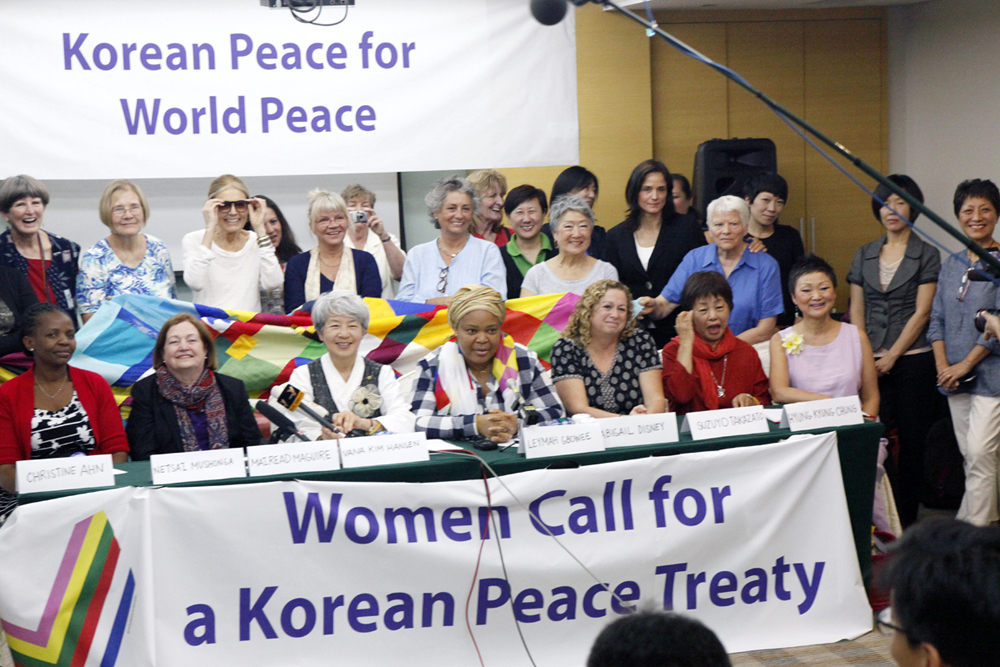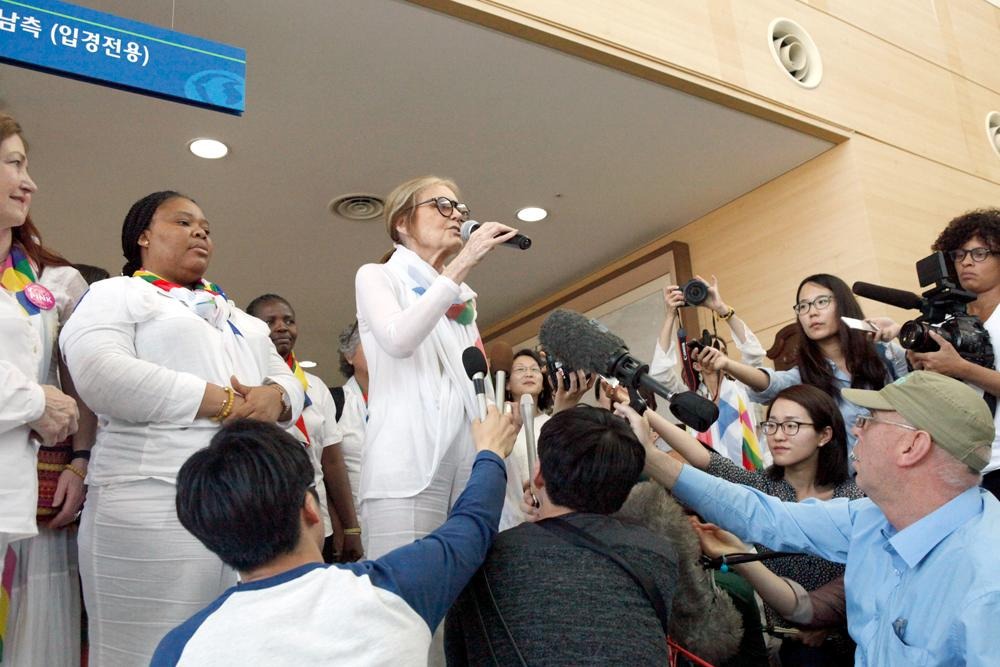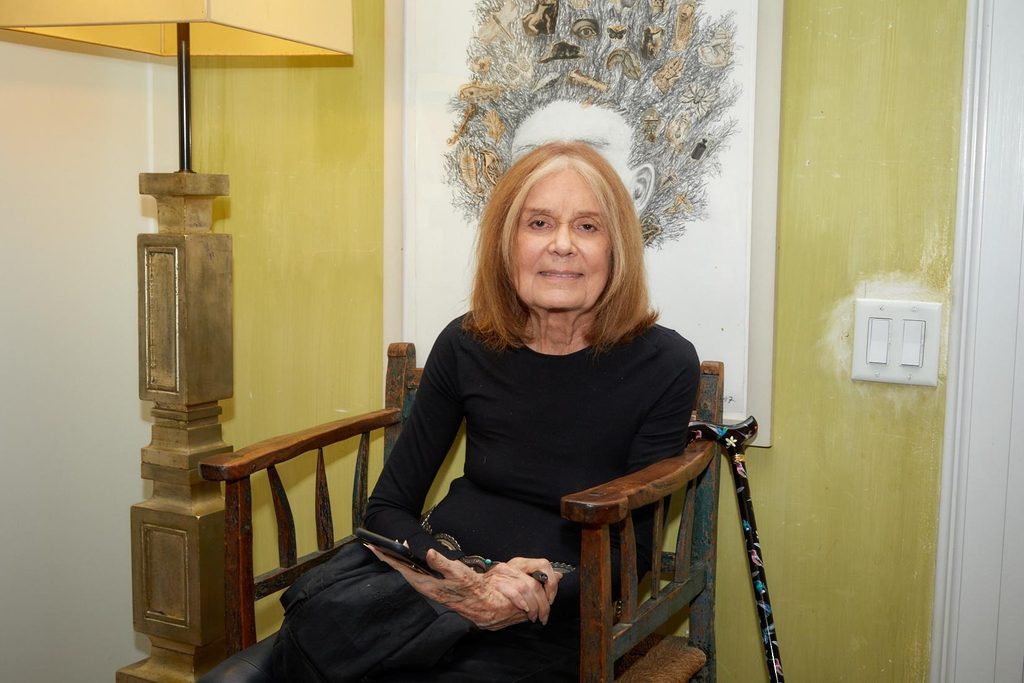
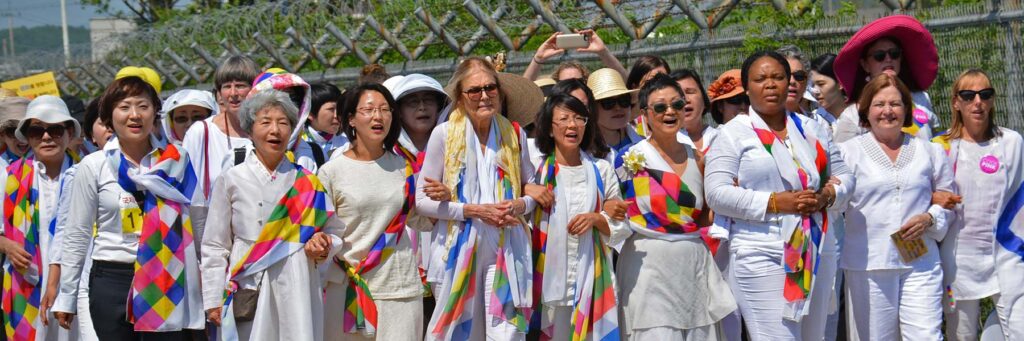
Women Cross DMZ mourns the passing of Gloria Steinem who played a central role in the 2015 Women’s Peace Walk and DMZ crossing. Gloria made lasting contributions to feminist movements in the U.S. and around the world, and later in her life developed a special passion for peace on the Korean peninsula.
In 2013, WCDMZ founder Christine Ahn emailed Gloria asking if she would consider a women’s peace walk across the demilitarized zone with a group of international women. Within an hour, she responded, “Yes — my high school classmates went to war there,” and that she wanted to do her small part to help bring healing and closure to the Korean War.
At the 2015 press conference at the United Nations Correspondents Association announcing the DMZ crossing, Gloria Steinem read her statement “Why I Am Walking for Peace and Reunification of Korea” (copied below).
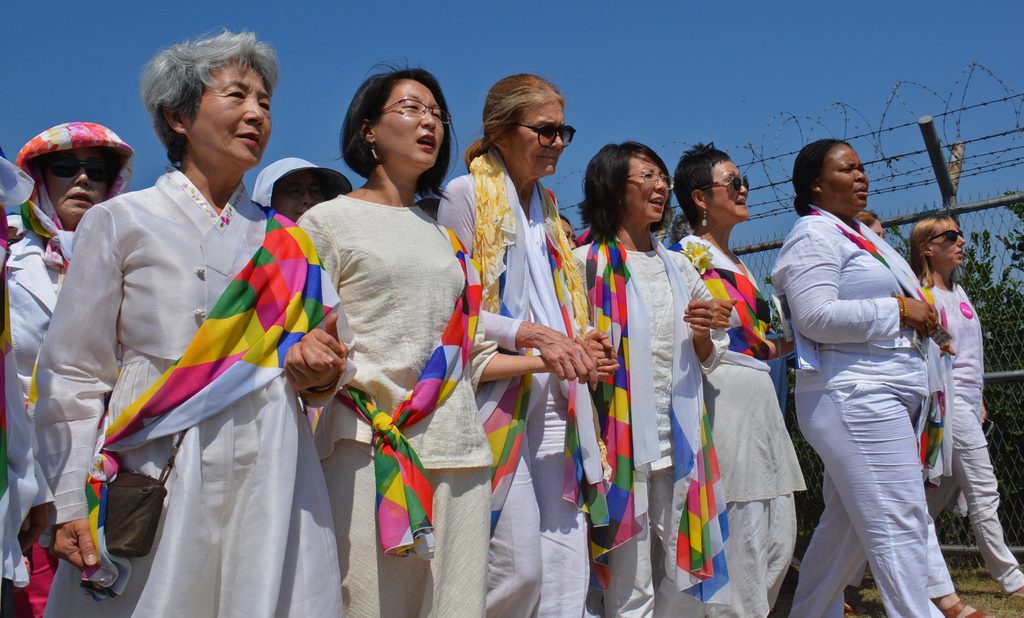
Throughout WCDMZ’s historic crossing — on the road to Pyongyang and across the Demilitarized Zone into South Korea — Gloria helped navigate every step, including many political landmines and entrenched hostilities. As the eldest delegate, she drew on decades of challenging political actions and helped the delegation stay on message. In the end, the delegation succeeded in getting all three governments — the DPRK, ROK and US — to agree on the crossing when they could agree on little else.
At a Women Cross DMZ reunion in 2018, Gloria reflected, “I consider my life in two parts: before the DMZ crossing, and after.”
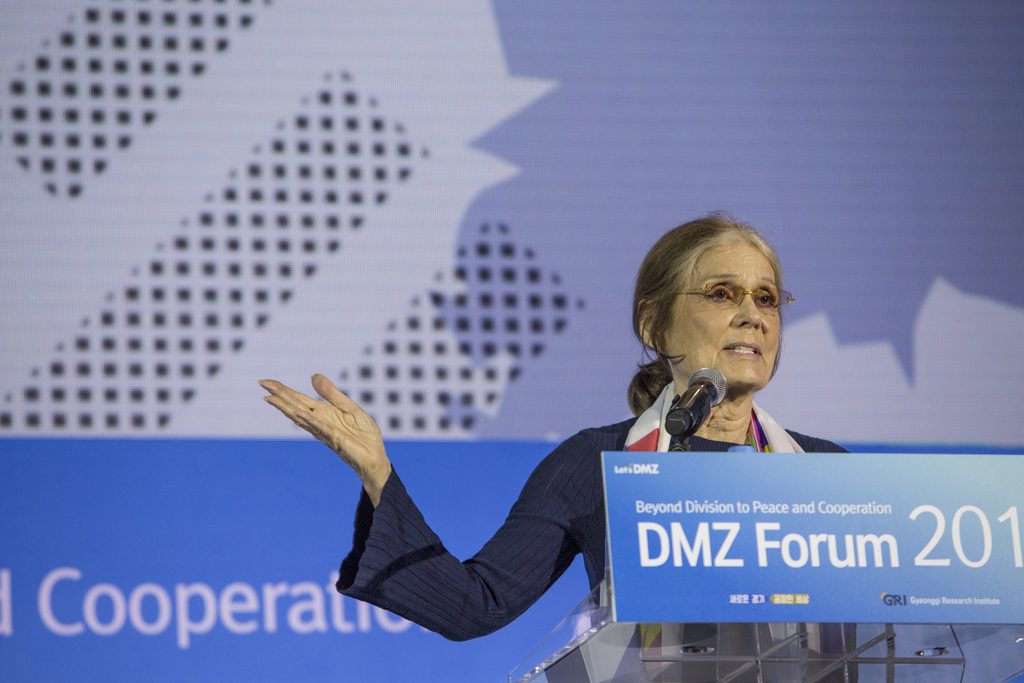
Her contributions to the Korea peace movement did not end with the crossing. She continued to speak and write about the need to end the Korean War, including in a 2019 Washington Post op-ed with Christine Ahn, “Women marched for Korean reconciliation. Washington is in our way.” She spoke before Congress, at the United Nations, and at various WCDMZ events on Korea peace and women’s leadership. In 2019 she traveled with WCDMZ to South Korea again to deliver the keynote address at the DMZ Peace Forum. She continuously offered her guidance, time, energy, and labor to the Korea peace movement to both Korean feminist leaders in South Korea and across the diaspora.
In 2019, Gloria wrote, “One of the most rewarding things I’ve ever done in my life was a Peace Walk Across the DMZ between North and South Korea, together with thirty women leaders from around the world.”
Thank you, Gloria, for all you gave to the Korea peace movement.
Read on for personal reflections from Christine Ahn, Grace Cho, Tina Insook Choi, and Sung-Hee Choi. If you would like to share your reflection on Gloria Steinem’s contribution to the Korea peace movement, please send it to info@womencrossdmz.org.
Gloria Steinem’s remarks at the UN Correspondents Press Conference, March 11, 2015
Why I Am Walking for Peace and Reunification of Korea
When I was in high school, my classmates were drafted in the Korean War. One of my classmate’s fathers who had been in WWII actually killed his son and killed himself rather than see his son go to war. I never forgot that.
I don’t know if we could have averted the Korean War, but because Americans participated in the war — and in the division after the war – we have an obligation to think about how the war can finally be declared over and a country unified.
I have stood on the South Korean side of the DMZ in a brand new railroad station; a symbol of hope that is empty and unused. It’s so close to North Korea that you can see the buildings on the other side. It symbolizes the separation between families; so close and yet so isolated. For these and many other reasons, when Korean-American women initiated this peace walk across the DMZ, I wanted to join.
I believe it’s crucial that women help initiate and pursue peace efforts. For cultural reasons, we don’t have “masculinity” to prove, and so it’s sometimes easier for us to make connections with other women across divisions. In Ireland, it was the women who crossed the boundaries of religion and region. For generations, those divisions seemed hopeless, yet now Ireland is a peaceful country. Women also crossed lines of religion to unite against warlords in Liberia, and bring about a peaceful election there.
Now we know from massive studies of every modern nation that the biggest indicator of whether a country is violent within itself, or is willing to use military violence against another country, is not poverty, or access to natural resources, or religion, or even degree of democracy; it’s violence and dominance against females. It normalizes all other dominance and violence because it’s the violence and domination we see first, perhaps even inside the family. It causes us to think the domination of one group by another is inevitable. The Women’s Peace March across the DMZ is a symbol of unification for North and South Korea, and peace between women and men. We can no longer afford violence and domination on this fragile Space Ship Earth.
###
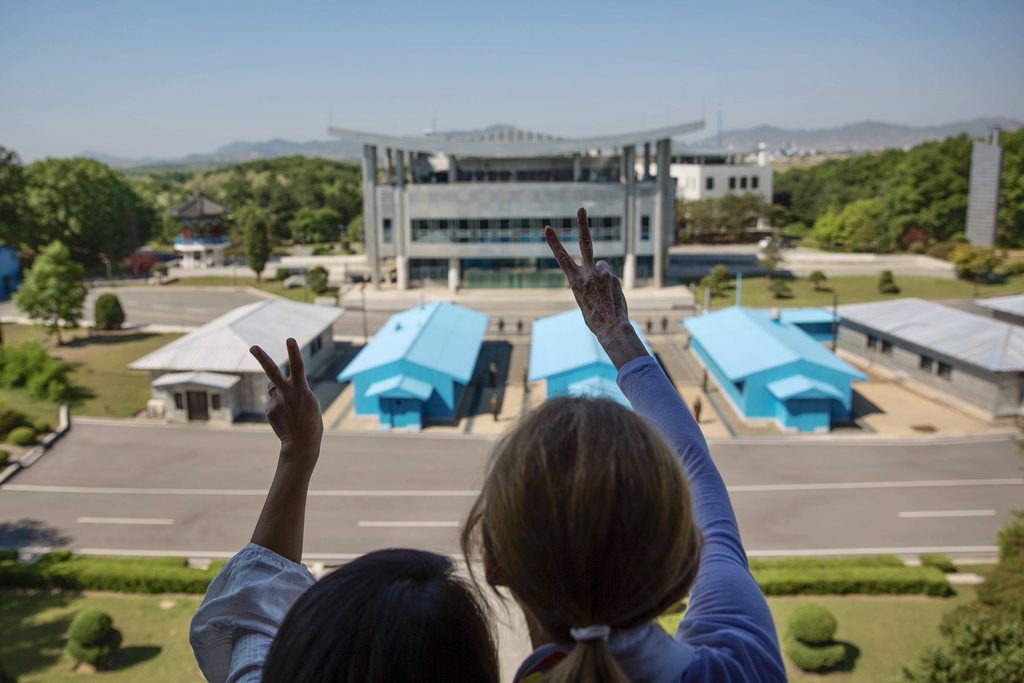
Icon. Wonder Woman. GOAT. She was all that and more, but my nickname for Gloria was “super,” which she was, but more like a building super with a massive set of keys that opened many doors.
I was among the circle of sisters privileged to stay with her when I came to NYC. We clicked the moment we first spoke over our effort to stop the naval base on Jeju Island.
In 2013 when I asked if she’d cross the DMZ with me, she wrote back yes, that she’d lost classmates in the War and she would help to bring healing and closure.
With Gloria on board, we proceeded to assemble a thirty-member international women’s delegation, including partnerships with organizations in the North and South. Gloria’s gift for narrative and effective use of media was crucial throughout our preparations.
While her obituaries lift up her lifelong feminist work, most omit her work for peace in Korea. Gloria spent political capital — and used many of her keys — to help us cross the DMZ. She was masterful in messaging: this was a walk by women for women, demonstrating with our bodies what we hoped would be done politically.
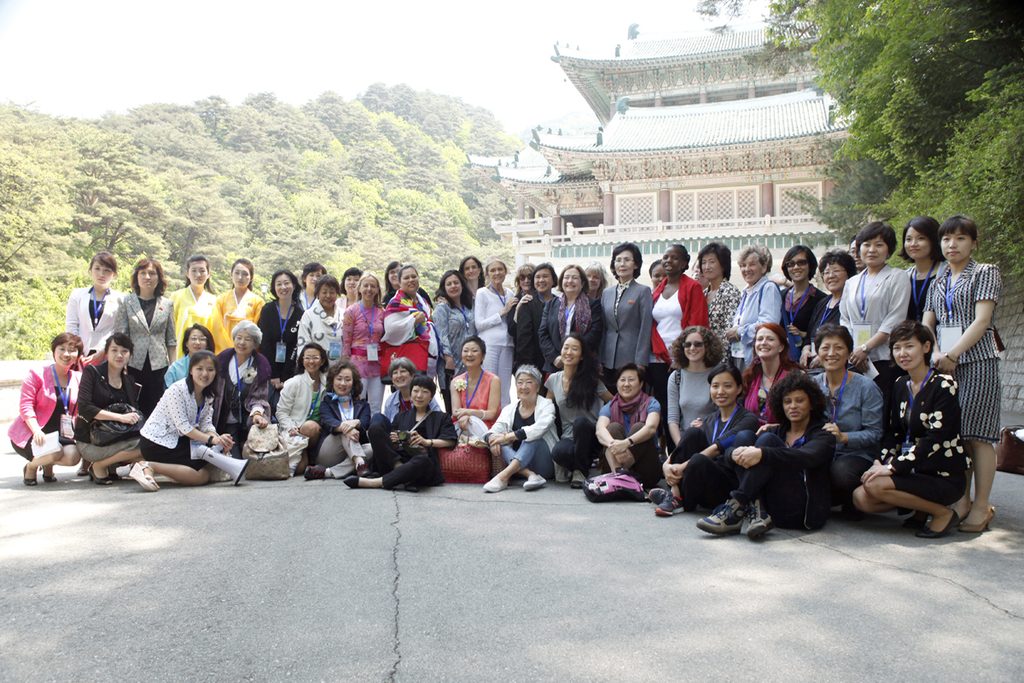
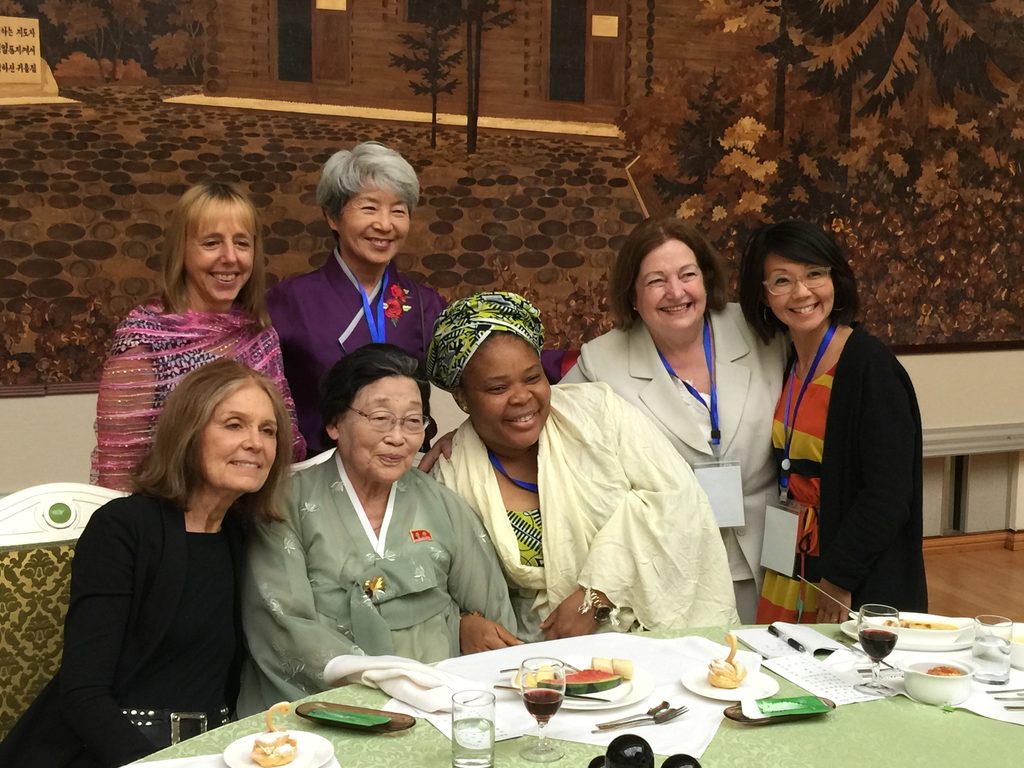
The first photo is of us in Kaesong, before the crossing. She wrapped her long arms around me and gave me a pep talk. She reminded me that we’d gotten three governments to agree on our crossing when they could agree on nothing else. This was a huge victory, and our job now was “to hold our heads high.”
At Dorasan Station, as journalists hounded us, Gloria said, “Christine is the heroine of this group, we should all be thanking her!” As I faced deportation and threats, she shielded me then as she did so often.
But our friendship went beyond activism. She was my wise sister who helped me find my own personal liberation. Once I called her before a flight, tearful and guilty about leaving my young daughter Jeju. Gloria said Jeju would know me as someone who pursued her dreams, and be shaped by watching her dad cook, clean, and care for her. And when I struggled to end my marriage, she told me it was important for me to model the relationship I wanted Jeju to see and to later have one day herself.
Gloria helped us raise funds, offered quotes for press releases, reviewed statements, and spoke on webinars and at multiple events. She hosted talk circles at her brownstone, and always welcomed me to stay with her. She loved our movement, which she called a “roving editorial peace committee.”
On one of my last visits, as we lay in bed sharing stories, she held my face and said, “Christine, you are a magical person. I believe you can do anything.” In Gloria fashion, I quipped, “that’s because you’ve sprinkled some of your fairy dust on me.”
I love and miss you, Gloria. Thank you for all you did for me, Jeju and all our movements. RIP to the Super.
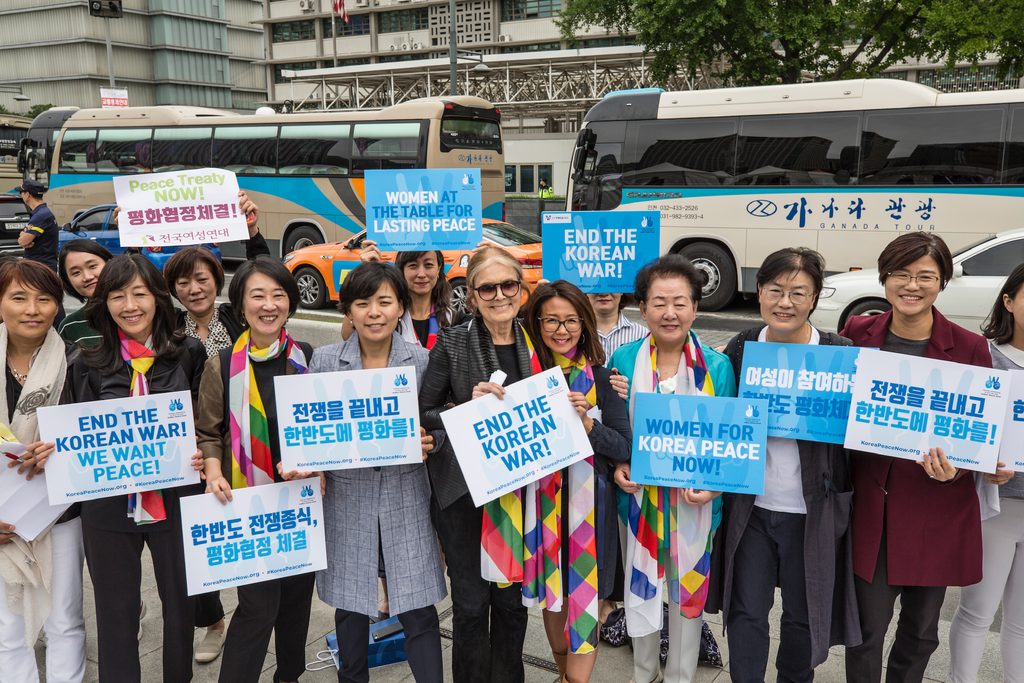
You probably won’t learn from any obituary that Gloria Steinem was a supporter of the Korean Peace movement. Here she is in 2015 with Women Cross DMZ, calling for a formal end to the Korean War. For that, and for all her trailblazing, I will always be grateful.
Original version:
페미니즘의 대모, 아이콘으로 불리는 여성 인권운동가이자 언론인인 글로리아 스타이넘이 향년 92세로 별세했다. 2002년 처음 한국을 방한했을 때부터 몇차례 함께 행사를 하며 늘 놀랐던 점은 언론으로만 보아 온 그의 행동과는 다르게 너무나도 부드럽고 포용적이었던 따뜻한 큰 언니의 모습을 보는 것이었다. 그중에서도 내게 가장 큰 울림을 주었던 We are not Ranked, We are Linked!는 여성운동이 추구해야 하는 가치가 포용하고 조화하는 여성성, 이를 위해 자신과 주변을 늘 연결하고 관계 맺으며 새로움을 창조하는 여성성이라는 것이다. 모든 여성들이 Linker가 되어 새로운 ‘살림Salim’의 문화를 만드는 것! 내게 여성운동의 지향점이 무엇인지를 깨닫게 해준 아직도 나의 가슴속에 깊이 남아 있는 말이다. 2011년 함께 DMZ를 처음 걸은 걸음은 2015년 세계 여성 평화 운동가들과 함께 북한에서 남한으로 DMZ(비무장지대)를 횡단하는 WomenCrossDMZ(WCD)으로 이어지며 한반도 평화를 위한 여성평화운동의 큰 기폭제가 되었다. 한국에서 페미니스트저널 이프가 창간하게된 계기를 주었고 성평등과 여성의 권리를 찾는데 힘을 주었고 한반도의 평화운동을 함께 해 온 아름다운 선배님~ 뉴욕자택에서 평화롭게 가셨다는 말에 그나마 안도하는 마음이 크지만 그래도 다가오는 슬픔에 지나온 추억을 떠 올리며 애도의 촛불을 켜 본다. 이제 평화의 안식처에서 편히 쉬시길 기도합니다.
English translation:
Gloria Steinem, a women’s rights activist and journalist known as the godmother and icon of feminism, has passed away at the age of 92. Since her first visit to Korea in 2002, I attended several events with her, and what always surprised me was seeing her as a warm, gentle, and inclusive older sister—a stark contrast to the behavior I had only seen through the media. Among her messages, the one that resonated most deeply with me was “We are not Ranked, We are Linked!” This implies that the values the women’s movement should pursue are a femininity of inclusiveness and harmony—a femininity that constantly connects itself with its surroundings, forms relationships, and creates something new. All women becoming Linkers to create a new culture of “Salim” (making things alive)! It is a phrase that still remains deep in my heart, having made me realize the true direction of the women’s movement. The first walk across the DMZ together in 2011 led to the Women Cross DMZ (WCDMZ) in 2015, a journey traversing the DMZ from North to South Korea with global women peace activists, becoming a major catalyst for the women’s peace movement for peace on the Korean Peninsula. You provided the impetus for the founding of the feminist journal *If* in Korea, gave strength to reclaim gender equality and women’s rights, and were a beautiful senior who walked alongside us in the peace movement on the Korean Peninsula. I feel a great sense of relief to hear that you passed away peacefully at your home in New York, and I light a candle of mourning as I recall our shared memories amidst the approaching sorrow at your passing. I pray that you now rest in peace in your sanctuary.
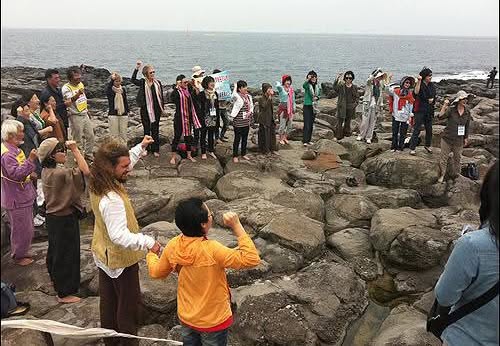
Original version:
글로리아 스타이넘의 명복을 빕니다
제주 해군기지 반대 및 제2공항 반대 투쟁에 연대하였던 미 여성운동가, 글로리아 스타이넘이 9월 2일 92세를 일기로 소천하였습니다. 삼가 고인의 명복을 빕니다.
글로리아 스타이넘은 세계적으로 잘 알려진 여성운동가인데 생애 후반 강정과 제주, 한반도에 보여준 관심과 연대 활동 역시 많은 주목을 받았습니다.
고인은 2011년 제주 강정마을을 방문하여 제주해군기지 반대 투쟁을 응원하였고 같은 해 뉴욕대학에서 고길천 작가와 함께 강정에 대해 강연한 일이 있습니다. 또한 2019년 제2공항 반대 국제 청원에 연명한 바 있습니다.
English translation:
Rest in Peace, Gloria Steinem
Gloria Steinem, an American women’s rights activist who stood in solidarity with the struggles against the Jeju Naval Base and the Second Airport, passed away on September 2 at the age of 92. We offer our deepest condolences.
Gloria Steinem was a globally renowned women’s rights activist, and the interest and solidarity she showed toward Gangjeong, Jeju, and the Korean Peninsula in the latter part of her life also received significant attention.
In 2011, she visited Gangjeong Village in Jeju to support the struggle against the Jeju Naval Base, and that same year, gave a lecture on Gangjeong at New York University alongside writer Ko Gil-cheon. She also co-signed an international petition against the Second Airport in 2019.