
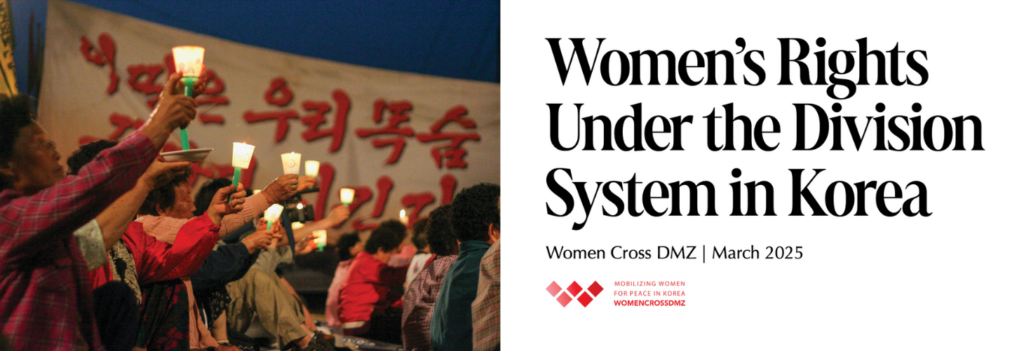
Women’s Rights Under the Division System in Korea

Women’s Rights Under the Division System in Korea

Women Cross DMZ has just released a new report, Women’s Rights Under the Division System in Korea, to shed light on the often overlooked consequences of Korea’s division on women’s lives. The report — the result of years of research and collaboration among Korean women across borders — exposes the profound and persistent impact of the division system and ongoing militarization on women’s human rights.

Released to coincide with International Women’s Day, the 69th Commission on the Status of Women at the United Nations, and the 80th year of Korea’s division, the report highlights key issues — including the presence of U.S. military bases, the gendered consequences of landmines and unexploded ordnance, and the enduring trauma of family separation — through personal narratives and expert analysis.

Among the key findings:

  • Human rights issues exacerbated by the 80-year division: Landmines and unexploded ordnance remnants in the Demilitarized Zone (DMZ) continue to cause significant harm to civilians, particularly women.
  • Militarization’s gendered impact: The ongoing U.S. military presence in South Korea and the expansion of military bases have significant human rights implications, particularly for women living in military camptowns, where they experience systemic sexual violence and exploitation. Furthermore, the expansion of U.S. military bases has displaced local farming communities.
  • The ongoing trauma of family separation: Millions of Korean families remain divided by the Korean War, with opportunities for reunification dwindling as separated family members age. The ongoing division has a particular impact on women who have borne the brunt of the emotional, social, and economic burdens of separation.

The report launch webinar features Korean language interpretation and report contributors and Korean women leaders:

  • Youngmi Cho, Executive Committee Member, Christian Conference of Asia; and Former Executive Director, Korean Women’s Movement for Peace
  • Lee Jung Ah, Standing Representative, Gyeonggi Women’s Association United
  • Lee Jae Jung, National Assembly member, ROK
  • Cathi Choi, Executive Director, Women Cross DMZ (moderator)

The report calls for a more comprehensive approach to human rights that prioritizes the needs and agency of the Korean people, and women in particular, and urges the two Koreas and the international community to take immediate action to address the gendered impacts of Korea’s ongoing division and to work toward sustainable peace on the peninsula.