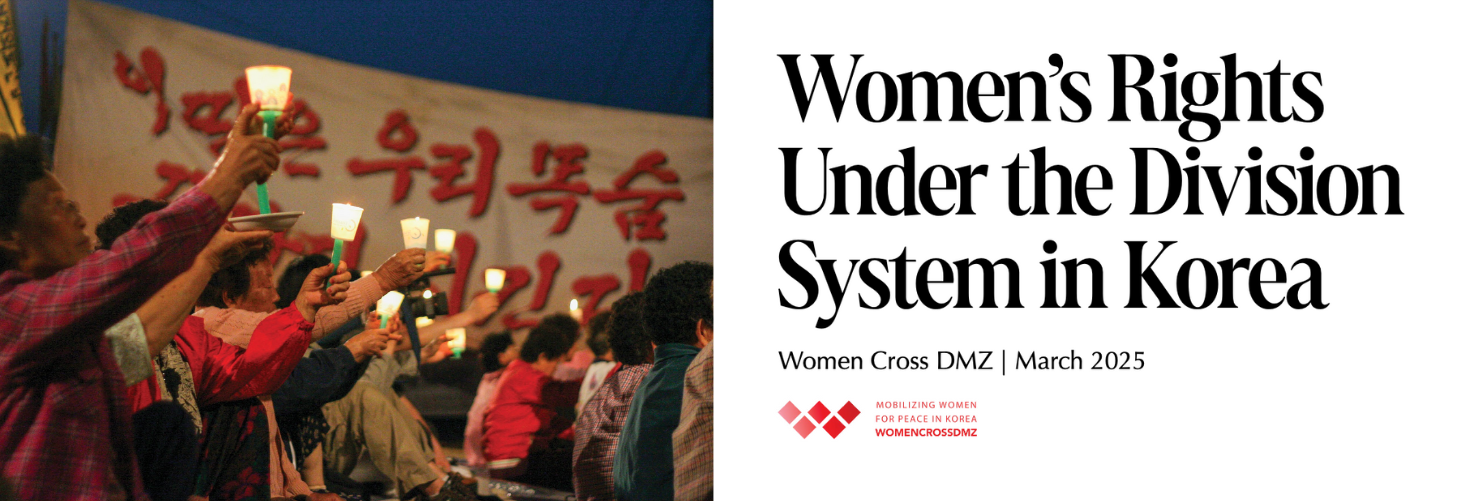
Women Cross DMZ has just released a new report, Women’s Rights Under the Division System in Korea, to shed light on the often overlooked consequences of Korea’s division on women’s lives. The report — the result of years of research and collaboration among Korean women across borders — exposes the profound and persistent impact of the division system and ongoing militarization on women’s human rights.
Released to coincide with International Women’s Day, the 69th Commission on the Status of Women at the United Nations, and the 80th year of Korea’s division, the report highlights key issues — including the presence of U.S. military bases, the gendered consequences of landmines and unexploded ordnance, and the enduring trauma of family separation — through personal narratives and expert analysis.
Among the key findings:
The report launch webinar features Korean language interpretation and report contributors and Korean women leaders:
The report calls for a more comprehensive approach to human rights that prioritizes the needs and agency of the Korean people, and women in particular, and urges the two Koreas and the international community to take immediate action to address the gendered impacts of Korea’s ongoing division and to work toward sustainable peace on the peninsula.
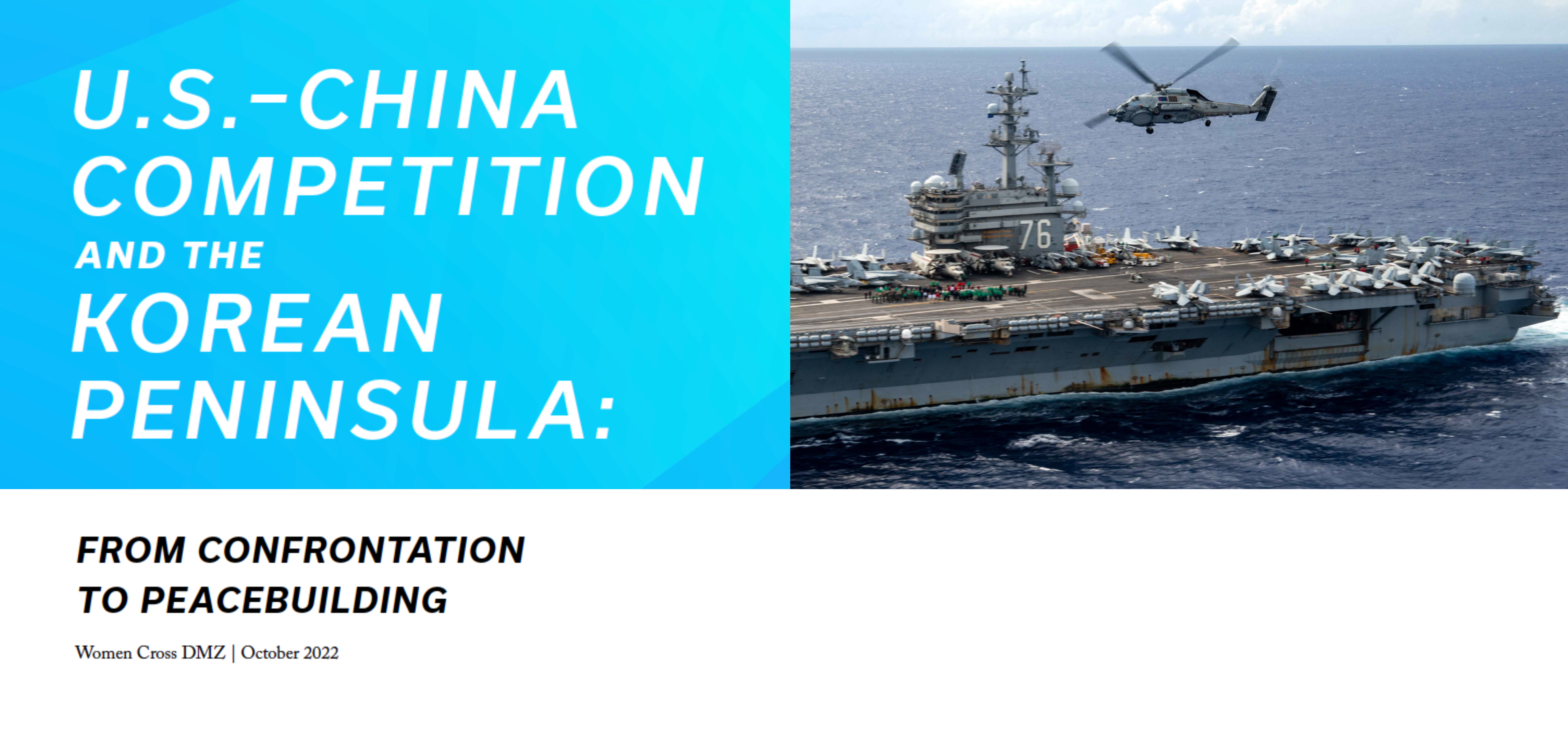
A new report, U.S.-China Competition and the Korean Peninsula: From Confrontation to Peacebuilding, shows how the Korean Peninsula has become the fault line for rising U.S.-China tensions. Released by Women Cross DMZ, the report argues that peacebuilding in Korea offers a much-needed opportunity for U.S.-China cooperation, which would help to reduce tensions, build trust, and, most crucially, avoid a possible war.
“With tensions running dangerously high on the Korean Peninsula, it is urgent that the Biden administration take a proactive approach through peaceful diplomacy,” said Christine Ahn, Executive Director of Women Cross DMZ. “This report shows that cooperating with China to officially end the Korean War would go a long way toward building a more peaceful and stable Northeast Asia.”
“China’s growing influence and Washington’s efforts to contain that influence through assembling an anti-China alliance in East Asia are promoting the relentless militarisation of the region,” said Kevin Gray, Professor in International Relations at the School of Global Studies at the University of Sussex and leading editor of the report. “This zero-sum competition between the two countries is also having highly negative implications for peace on the Korean Peninsula. However, tackling the seven-decade long unended war in Korea will conversely provide an opportunity for Washington and Beijing to establish areas of cooperation between the two countries while limiting the potential of war in the region.”
“South Korea is increasingly being caught up in the rivalry between the United States and China, which is inflaming tensions with North Korea,” said Youkyoung Ko, an author of the report and representative of the Women’s International League for Peace and Freedom. “Rather than escalating the situation by continuing the arms race, the U.S. and China should work to reduce tensions by cooperating on officially ending the Korean War.”
“There needs to be support for local and transnational civil society peace initiatives to increase interactions across the DMZ on the Korean Peninsula and establish the conditions for genuine peace in East Asia, and beyond,” said Dong Jin Kim, a Senior Research Fellow in Peace and Reconciliation Studies at Trinity College Dublin.
“At a time when U.S.—China relations are veering toward conflict, this report shows the urgent need for cooperation between Washington and Beijing, and it offers a vital issue — peace and diplomacy on the Korean Peninsula — on which U.S.—China cooperation would help all sides turn away from a disastrous great power conflict,” said Jake Werner, Research Fellow at Quincy Institute for Responsible Statecraft.
Among the key findings of the report:
As the authors argue, the United States must pivot away from its current zero-sum approach towards a human security framework that centers frontline communities, prioritizes the resolution of conflict through diplomatic means, and avoids war at all costs.
Report Launch Event
Join us for a discussion of U.S.-China Competition and the Korean Peninsula: From Confrontation to Peacebuilding with the report’s authors, followed by a Q&A. Wednesday, October 26, 2022, 10am ET.
Speakers: